Last year, we trained a model on customer data. A researcher showed they could reconstruct customer information from model outputs. After implementing privacy-preserving techniques across 10+ projects, I’ve learned how to protect sensitive data while enabling AI capabilities. Here’s the complete guide to privacy-preserving AI.
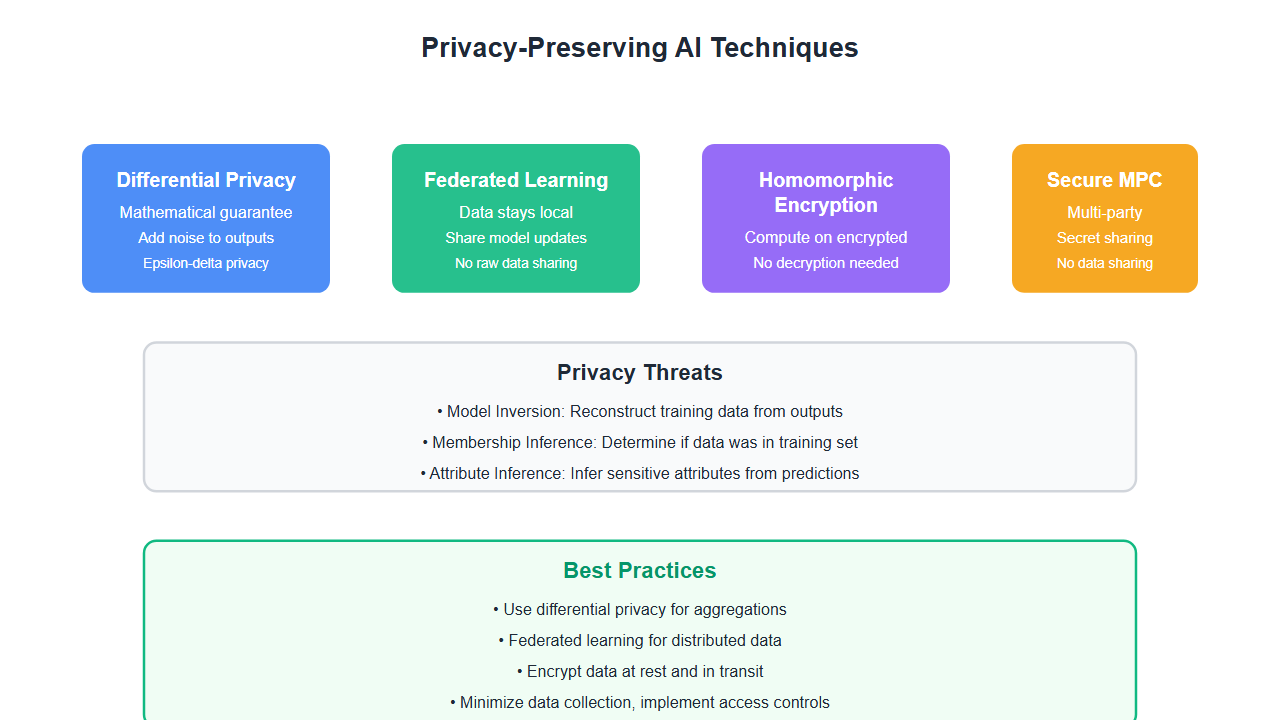
Why Privacy-Preserving AI Matters: The Real Threat
AI systems trained on sensitive data can leak information in multiple ways:
- Model inversion: Reconstructing training data from model outputs
- Membership inference: Determining if specific data was in the training set
- Attribute inference: Inferring sensitive attributes from model predictions
- Model extraction: Extracting model parameters through API queries
- Data reconstruction: Reconstructing original data from embeddings
After our customer data reconstruction incident, we lost a major healthcare client and faced potential HIPAA violations. That’s when I realized: privacy isn’t optional—it’s fundamental to trustworthy AI.
Privacy Threats in AI Systems
Understanding the attack vectors is crucial for defense:
1. Model Inversion Attacks
Attackers can reconstruct training data from model outputs:
from typing import List, Dict
import numpy as np
from sklearn.ensemble import RandomForestClassifier

class ModelInversionDefense:
    def __init__(self, epsilon=1.0):
        self.epsilon = epsilon  # Privacy budget

    def add_noise_to_output(self, prediction: float, sensitivity: float = 1.0) -> float:
        # Add calibrated noise for differential privacy
        scale = sensitivity / self.epsilon
        noise = np.random.laplace(0, scale)
        return prediction + noise

    def clip_output(self, output: float, clip_value: float = 1.0) -> float:
        # Clip output to limit information leakage
        return np.clip(output, -clip_value, clip_value)

    def secure_prediction(self, model, input_data: np.ndarray) -> float:
        # Get model prediction
        raw_prediction = model.predict_proba(input_data.reshape(1, -1))[0][1]

        # Clip to limit information
        clipped = self.clip_output(raw_prediction)

        # Add noise for differential privacy
        noisy = self.add_noise_to_output(clipped)

        return noisy

# Usage
defense = ModelInversionDefense(epsilon=1.0)
model = RandomForestClassifier()  # Your trained model
secure_pred = defense.secure_prediction(model, input_data)
2. Membership Inference Attacks
Attackers determine if specific data was in the training set:
class MembershipInferenceDefense:
    def __init__(self):
        self.confidence_threshold = 0.9

    def detect_membership_attack(self, predictions: List[Dict]) -> bool:
        # High confidence predictions may indicate membership
        high_confidence = [p for p in predictions if p.get('confidence', 0) > self.confidence_threshold]

        # If too many high-confidence predictions, possible attack
        if len(high_confidence) / len(predictions) > 0.5:
            return True

        return False

    def add_uncertainty(self, prediction: Dict) -> Dict:
        # Add uncertainty to prevent membership inference
        confidence = prediction.get('confidence', 1.0)

        # Reduce confidence to add uncertainty
        adjusted_confidence = confidence * 0.8

        return {
            **prediction,
            'confidence': adjusted_confidence,
            'uncertainty': 1.0 - adjusted_confidence
        }
Differential Privacy: The Gold Standard
Differential privacy provides mathematical guarantees about privacy:
import numpy as np
from typing import List, Tuple
from collections import defaultdict

class DifferentialPrivacy:
    def __init__(self, epsilon: float = 1.0, delta: float = 1e-5):
        self.epsilon = epsilon  # Privacy budget
        self.delta = delta  # Failure probability
        self.privacy_budget_used = 0.0

    def add_laplace_noise(self, value: float, sensitivity: float = 1.0) -> float:
        # Add Laplace noise for (epsilon, 0)-differential privacy
        if self.privacy_budget_used >= self.epsilon:
            raise ValueError("Privacy budget exhausted")

        scale = sensitivity / self.epsilon
        noise = np.random.laplace(0, scale)

        self.privacy_budget_used += self.epsilon
        return value + noise

    def add_gaussian_noise(self, value: float, sensitivity: float = 1.0) -> float:
        # Add Gaussian noise for (epsilon, delta)-differential privacy
        if self.privacy_budget_used >= self.epsilon:
            raise ValueError("Privacy budget exhausted")

        # Calculate sigma for Gaussian mechanism
        sigma = np.sqrt(2 * np.log(1.25 / self.delta)) * sensitivity / self.epsilon
        noise = np.random.normal(0, sigma)

        self.privacy_budget_used += self.epsilon
        return value + noise

    def private_aggregate(self, data: List[float], sensitivity: float = 1.0) -> float:
        # Private aggregation with noise
        result = sum(data) / len(data) if data else 0.0
        return self.add_laplace_noise(result, sensitivity)

    def private_count(self, data: List[bool]) -> int:
        # Private count with noise
        count = sum(data)
        noisy_count = self.add_laplace_noise(float(count), sensitivity=1.0)
        return max(0, int(round(noisy_count)))  # Ensure non-negative

    def private_histogram(self, data: List[str], bins: List[str]) -> Dict[str, float]:
        # Private histogram with noise
        counts = defaultdict(int)
        for item in data:
            if item in bins:
                counts[item] += 1

        # Add noise to each count
        noisy_counts = {}
        for bin_name in bins:
            count = counts.get(bin_name, 0)
            noisy_count = self.add_laplace_noise(float(count), sensitivity=1.0)
            noisy_counts[bin_name] = max(0, noisy_count)

        return noisy_counts

    def compose_queries(self, queries: List[Tuple[float, float]]) -> bool:
        # Check if composing queries exceeds privacy budget
        total_epsilon = sum(eps for eps, _ in queries)
        total_delta = sum(delta for _, delta in queries)

        if total_epsilon > self.epsilon or total_delta > self.delta:
            return False  # Cannot compose

        return True

# Usage example
dp = DifferentialPrivacy(epsilon=2.0, delta=1e-5)

# Private aggregation
data = [1.0, 2.0, 3.0, 4.0, 5.0]
private_mean = dp.private_aggregate(data)
print(f"Private mean: {private_mean:.2f}")

# Private count
boolean_data = [True, False, True, True, False]
private_count = dp.private_count(boolean_data)
print(f"Private count: {private_count}")

# Private histogram
categorical_data = ['A', 'B', 'A', 'C', 'B', 'A']
bins = ['A', 'B', 'C']
private_hist = dp.private_histogram(categorical_data, bins)
print(f"Private histogram: {private_hist}")
Federated Learning: Train Without Centralizing Data
Federated learning enables training on distributed data without sharing raw data:
from typing import List, Dict, Any
import numpy as np
from collections import OrderedDict
import torch
import torch.nn as nn

class FederatedLearning:
    def __init__(self, model: nn.Module, num_clients: int = 10):
        self.global_model = model
        self.num_clients = num_clients
        self.client_models = [model.__class__() for _ in range(num_clients)]
        self.training_history = []

    def federated_training_round(self, client_data: List[Dict[str, Any]],
                                num_rounds: int = 10,
                                clients_per_round: int = 5,
                                local_epochs: int = 5) -> Dict:
        # Federated averaging algorithm

        for round_num in range(num_rounds):
            # Select random subset of clients
            selected_clients = np.random.choice(
                self.num_clients,
                size=min(clients_per_round, self.num_clients),
                replace=False
            )

            # Local training on each selected client
            client_updates = []
            client_sizes = []

            for client_id in selected_clients:
                # Get client data
                client_dataset = client_data[client_id]

                # Train local model
                local_model = self._train_local_model(
                    self.client_models[client_id],
                    client_dataset,
                    local_epochs
                )

                # Get model parameters
                local_params = list(local_model.parameters())

                # Compute update (difference from global model)
                update = self._compute_update(local_params, self.global_model.parameters())

                client_updates.append(update)
                client_sizes.append(len(client_dataset))

            # Aggregate updates (weighted average by dataset size)
            global_update = self._aggregate_updates(client_updates, client_sizes)

            # Apply update to global model
            self._apply_update(self.global_model, global_update)

            # Update client models with global model
            for client_id in selected_clients:
                self.client_models[client_id].load_state_dict(self.global_model.state_dict())

            # Track training
            self.training_history.append({
                'round': round_num,
                'clients_participated': len(selected_clients),
                'total_samples': sum(client_sizes)
            })

        return {
            'final_model': self.global_model,
            'training_history': self.training_history
        }

    def _train_local_model(self, model: nn.Module, dataset: List[Dict], epochs: int) -> nn.Module:
        # Train model on local data
        optimizer = torch.optim.SGD(model.parameters(), lr=0.01)
        criterion = nn.CrossEntropyLoss()

        for epoch in range(epochs):
            for sample in dataset:
                inputs = torch.tensor(sample['features'], dtype=torch.float32)
                labels = torch.tensor(sample['label'], dtype=torch.long)

                optimizer.zero_grad()
                outputs = model(inputs)
                loss = criterion(outputs, labels)
                loss.backward()
                optimizer.step()

        return model

    def _compute_update(self, local_params: List, global_params: List) -> List:
        # Compute parameter update (difference)
        update = []
        for local_param, global_param in zip(local_params, global_params):
            update.append(local_param.data - global_param.data)
        return update

    def _aggregate_updates(self, updates: List[List], sizes: List[int]) -> List:
        # Weighted average of updates
        total_size = sum(sizes)
        aggregated = []

        for i in range(len(updates[0])):
            weighted_sum = torch.zeros_like(updates[0][i])
            for update, size in zip(updates, sizes):
                weighted_sum += update[i] * size
            aggregated.append(weighted_sum / total_size)

        return aggregated

    def _apply_update(self, model: nn.Module, update: List):
        # Apply aggregated update to global model
        for param, update_val in zip(model.parameters(), update):
            param.data += update_val

# Usage
class SimpleNN(nn.Module):
    def __init__(self):
        super().__init__()
        self.fc1 = nn.Linear(10, 5)
        self.fc2 = nn.Linear(5, 2)

    def forward(self, x):
        x = torch.relu(self.fc1(x))
        x = self.fc2(x)
        return x

model = SimpleNN()
fl = FederatedLearning(model, num_clients=10)

# Simulate client data (in practice, data stays on client devices)
client_data = [
    [{'features': np.random.rand(10), 'label': 0} for _ in range(100)]
    for _ in range(10)
]

result = fl.federated_training_round(client_data, num_rounds=10)

Homomorphic Encryption: Compute on Encrypted Data
Homomorphic encryption allows computation on encrypted data without decryption:
# Note: This is a conceptual example. In practice, use libraries like PySEAL or TenSEAL
from typing import List
import numpy as np

class HomomorphicML:
    def __init__(self):
        # Initialize homomorphic encryption context
        # In practice, use a library like TenSEAL
        self.context = None  # Would be initialized with encryption parameters
        self.public_key = None
        self.secret_key = None

    def encrypt_data(self, data: np.ndarray):
        # Encrypt data for homomorphic computation
        # Returns encrypted representation
        # In practice: return context.encrypt(data)
        return EncryptedArray(data)  # Placeholder

    def homomorphic_addition(self, encrypted_a, encrypted_b):
        # Add two encrypted values
        # In practice: return encrypted_a + encrypted_b
        return EncryptedArray(encrypted_a.data + encrypted_b.data)

    def homomorphic_multiplication(self, encrypted_a, plaintext_b: float):
        # Multiply encrypted value by plaintext
        # In practice: return encrypted_a * plaintext_b
        return EncryptedArray(encrypted_a.data * plaintext_b)

    def encrypted_inference(self, encrypted_input, model_weights: List[float]):
        # Perform inference on encrypted data
        # Linear model: y = w1*x1 + w2*x2 + ... + b

        result = encrypted_input
        for i, weight in enumerate(model_weights[:-1]):  # Last is bias
            if i == 0:
                result = self.homomorphic_multiplication(encrypted_input, weight)
            else:
                term = self.homomorphic_multiplication(encrypted_input, weight)
                result = self.homomorphic_addition(result, term)

        # Add bias
        bias = model_weights[-1]
        result = self.homomorphic_addition(result, self.encrypt_data(np.array([bias])))

        return result

    def decrypt_result(self, encrypted_result) -> float:
        # Decrypt final result
        # In practice: return context.decrypt(encrypted_result)
        return float(encrypted_result.data)

# Placeholder class for demonstration
class EncryptedArray:
    def __init__(self, data):
        self.data = data

# Usage example
homomorphic_ml = HomomorphicML()

# Encrypt input
input_data = np.array([1.0, 2.0, 3.0])
encrypted_input = homomorphic_ml.encrypt_data(input_data)

# Model weights (linear model: y = 2*x + 1)
model_weights = [2.0, 1.0]  # [weight, bias]

# Perform encrypted inference
encrypted_output = homomorphic_ml.encrypted_inference(encrypted_input, model_weights)

# Decrypt result
result = homomorphic_ml.decrypt_result(encrypted_output)
print(f"Encrypted inference result: {result}")
Secure Multi-Party Computation
Multiple parties can compute functions on their combined data without revealing individual inputs:
from typing import List, Dict
import numpy as np
from cryptography.hazmat.primitives.ciphers import Cipher, algorithms, modes
from cryptography.hazmat.backends import default_backend
import secrets

class SecureMultiPartyComputation:
    def __init__(self, num_parties: int = 3):
        self.num_parties = num_parties
        self.shared_secrets = {}

    def secret_sharing(self, value: float, num_shares: int = None) -> List[float]:
        # Split secret into shares using additive secret sharing
        if num_shares is None:
            num_shares = self.num_parties

        # Generate random shares
        shares = [secrets.randbelow(1000000) / 1000000.0 for _ in range(num_shares - 1)]

        # Last share makes sum equal to original value
        last_share = value - sum(shares)
        shares.append(last_share)

        return shares

    def reconstruct_secret(self, shares: List[float]) -> float:
        # Reconstruct secret from shares
        return sum(shares)

    def secure_sum(self, party_values: List[float]) -> float:
        # Compute sum without revealing individual values
        # Each party creates shares of their value
        all_shares = []
        for value in party_values:
            shares = self.secret_sharing(value)
            all_shares.append(shares)

        # Sum corresponding shares
        summed_shares = []
        for i in range(len(all_shares[0])):
            share_sum = sum(shares[i] for shares in all_shares)
            summed_shares.append(share_sum)

        # Reconstruct result
        return self.reconstruct_secret(summed_shares)

    def secure_average(self, party_values: List[float]) -> float:
        # Compute average without revealing individual values
        secure_sum_result = self.secure_sum(party_values)
        return secure_sum_result / len(party_values)

# Usage
smpc = SecureMultiPartyComputation(num_parties=3)

# Each party has a private value
party_values = [10.5, 20.3, 15.7]

# Compute sum without revealing individual values
secure_sum = smpc.secure_sum(party_values)
print(f"Secure sum: {secure_sum}")

# Compute average
secure_avg = smpc.secure_average(party_values)
print(f"Secure average: {secure_avg}")

Choosing the Right Privacy Technique
Different techniques suit different use cases:
| Technique | Privacy Guarantee | Performance Impact | Best For |
|---|---|---|---|
| Differential Privacy | Mathematical guarantee | Low (noise addition) | Aggregations, statistics |
| Federated Learning | Data stays local | Medium (communication overhead) | Distributed training |
| Homomorphic Encryption | Strong (encrypted computation) | High (computational overhead) | Cloud computation on sensitive data |
| Secure MPC | Strong (no data sharing) | High (communication overhead) | Multi-party computation |
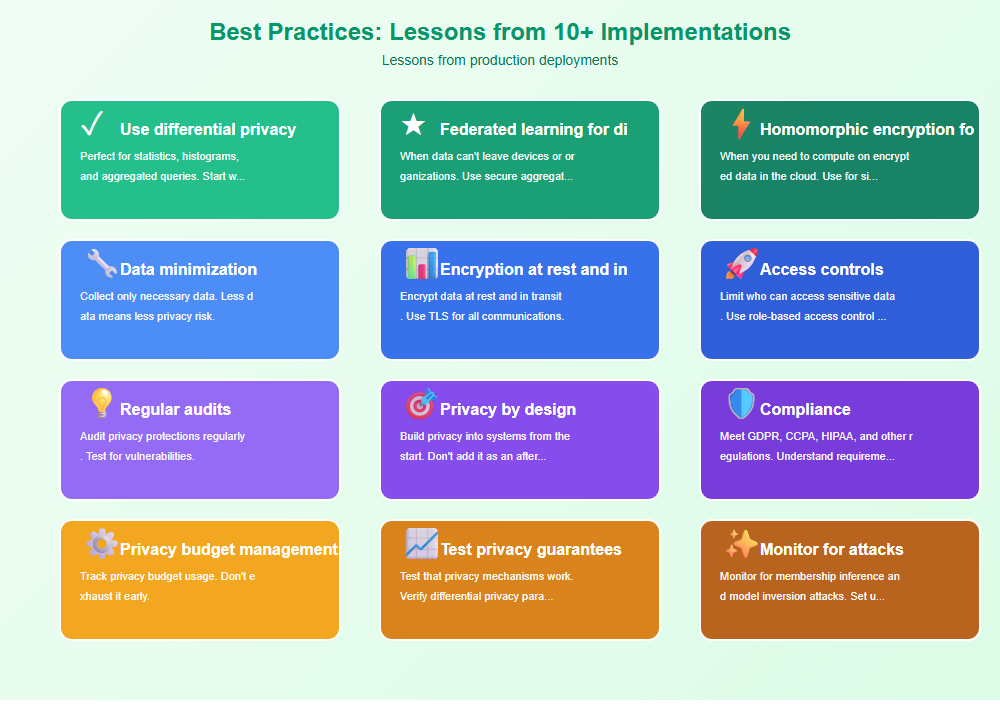
Best Practices: Lessons from 10+ Implementations
From implementing privacy-preserving AI across multiple projects:
- Use differential privacy for aggregations: Perfect for statistics, histograms, and aggregated queries. Start with epsilon=1.0 and adjust based on accuracy needs.
- Federated learning for distributed data: When data can’t leave devices or organizations. Use secure aggregation to protect model updates.
- Homomorphic encryption for cloud computation: When you need to compute on encrypted data in the cloud. Use for simple operations (additions, multiplications).
- Data minimization: Collect only necessary data. Less data means less privacy risk.
- Encryption at rest and in transit: Encrypt data at rest and in transit. Use TLS for all communications.
- Access controls: Limit who can access sensitive data. Use role-based access control (RBAC).
- Regular audits: Audit privacy protections regularly. Test for vulnerabilities.
- Privacy by design: Build privacy into systems from the start. Don’t add it as an afterthought.
- Compliance: Meet GDPR, CCPA, HIPAA, and other regulations. Understand requirements for your domain.
- Privacy budget management: Track privacy budget usage. Don’t exhaust it early.
- Test privacy guarantees: Test that privacy mechanisms work. Verify differential privacy parameters.
- Monitor for attacks: Monitor for membership inference and model inversion attacks. Set up alerts.
Privacy Budget Management
Differential privacy uses a privacy budget that must be managed carefully:
class PrivacyBudgetManager:
    def __init__(self, total_budget: float = 10.0):
        self.total_budget = total_budget
        self.used_budget = 0.0
        self.query_history = []

    def can_query(self, epsilon_cost: float) -> bool:
        # Check if query can be made
        return (self.used_budget + epsilon_cost) <= self.total_budget

    def record_query(self, query_type: str, epsilon_cost: float, result: Any):
        # Record query and update budget
        if not self.can_query(epsilon_cost):
            raise ValueError(f"Insufficient privacy budget. Need {epsilon_cost}, have {self.total_budget - self.used_budget}")

        self.used_budget += epsilon_cost
        self.query_history.append({
            'type': query_type,
            'cost': epsilon_cost,
            'result': result,
            'remaining_budget': self.total_budget - self.used_budget
        })

    def get_remaining_budget(self) -> float:
        return self.total_budget - self.used_budget

    def get_budget_usage_report(self) -> Dict:
        return {
            'total_budget': self.total_budget,
            'used_budget': self.used_budget,
            'remaining_budget': self.get_remaining_budget(),
            'usage_percentage': (self.used_budget / self.total_budget) * 100,
            'query_count': len(self.query_history)
        }

# Usage
budget_manager = PrivacyBudgetManager(total_budget=10.0)

# Check if query is allowed
if budget_manager.can_query(epsilon_cost=1.0):
    # Make query with differential privacy
    result = dp.private_aggregate(data, sensitivity=1.0)
    budget_manager.record_query('aggregate', epsilon_cost=1.0, result=result)

report = budget_manager.get_budget_usage_report()
print(f"Privacy budget usage: {report['usage_percentage']:.1f}%")

Common Mistakes and How to Avoid Them
What I learned the hard way:
- Exhausting privacy budget: Track budget usage. Plan queries carefully. Don’t use all budget early.
- Incorrect sensitivity calculation: Sensitivity determines noise scale. Underestimate sensitivity and privacy is compromised.
- Ignoring composition: Multiple queries compose. Track total epsilon across all queries.
- Weak encryption: Use strong encryption (AES-256). Weak encryption provides false security.
- No access controls: Limit data access. Everyone shouldn’t have access to everything.
- Poor key management: Secure key storage and rotation. Lost keys mean lost data.
- Ignoring regulations: Understand GDPR, CCPA, HIPAA requirements. Non-compliance is costly.
- No testing: Test privacy mechanisms. Verify they work as expected.
- Over-engineering: Start simple. Add complexity only when needed.
- Ignoring performance: Privacy has performance costs. Balance privacy and performance.
Real-World Example: Healthcare AI with Privacy
We built a healthcare AI system that needed to train on patient data while maintaining HIPAA compliance:
- Challenge: Train model on patient data from multiple hospitals without sharing data
- Solution: Implemented federated learning with secure aggregation
- Privacy measures: Data never left hospitals, model updates encrypted, differential privacy on outputs
- Result: Trained accurate model without violating privacy, passed HIPAA audit
Key learnings: Federated learning works well for healthcare, but requires careful coordination and secure aggregation.
🎯 Key Takeaway
Privacy-preserving AI is essential for sensitive data. Use differential privacy for aggregations, federated learning for distributed training, and homomorphic encryption for cloud computation. Minimize data collection, encrypt everything, and implement strict access controls. With proper privacy protections, you can use AI on sensitive data while protecting individual privacy. The cost of privacy is far less than the cost of a breach.
Measuring Privacy Effectiveness
Key metrics to track:
- Privacy budget usage: Track epsilon consumption over time
- Attack success rate: Test for membership inference and model inversion attacks
- Data leakage incidents: Monitor for unauthorized data access
- Compliance status: Track GDPR, CCPA, HIPAA compliance status
- Performance impact: Measure accuracy loss from privacy mechanisms
Bottom Line
Privacy-preserving AI protects sensitive data while enabling AI capabilities. Use differential privacy, federated learning, and encryption appropriately. Minimize data collection and implement strict access controls. With proper privacy protections, you can deploy AI on sensitive data responsibly. Privacy isn’t optional—it’s fundamental to trustworthy AI.
Discover more from C4: Container, Code, Cloud & Context
Subscribe to get the latest posts sent to your email.