Introduction: Fine-tuning transforms general-purpose LLMs into specialized models that excel at your specific tasks. While prompting can get you far, fine-tuning unlocks capabilities that prompting alone cannot achieve: consistent output formats, domain-specific knowledge, reduced latency from shorter prompts, and behavior that would require extensive few-shot examples. This guide covers the practical aspects of LLM fine-tuning: preparing training data, choosing between full fine-tuning and parameter-efficient methods like LoRA and QLoRA, implementing training loops with proper evaluation, and deploying fine-tuned models. Whether you’re building a customer service bot that matches your brand voice or a code assistant trained on your codebase, these patterns will help you create models that truly fit your needs.
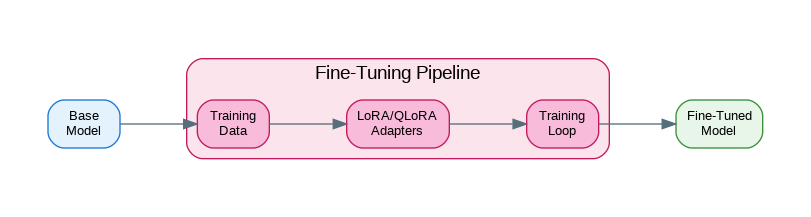
Training Data Preparation
from dataclasses import dataclass, field
from typing import Any, Optional
from abc import ABC, abstractmethod
import json

@dataclass
class TrainingExample:
    """A single training example."""

    instruction: str
    input: str = ""
    output: str = ""
    system: str = ""

    def to_alpaca_format(self) -> dict:
        """Convert to Alpaca format."""

        return {
            "instruction": self.instruction,
            "input": self.input,
            "output": self.output
        }

    def to_chat_format(self) -> dict:
        """Convert to chat format."""

        messages = []

        if self.system:
            messages.append({"role": "system", "content": self.system})

        user_content = self.instruction
        if self.input:
            user_content += f"\n\n{self.input}"

        messages.append({"role": "user", "content": user_content})
        messages.append({"role": "assistant", "content": self.output})

        return {"messages": messages}

    def to_completion_format(self, template: str = None) -> dict:
        """Convert to completion format."""

        if template:
            prompt = template.format(
                instruction=self.instruction,
                input=self.input
            )
        else:
            prompt = f"### Instruction:\n{self.instruction}"
            if self.input:
                prompt += f"\n\n### Input:\n{self.input}"
            prompt += "\n\n### Response:\n"

        return {
            "prompt": prompt,
            "completion": self.output
        }

class DatasetFormatter:
    """Format datasets for fine-tuning."""

    def __init__(self, format_type: str = "chat"):
        self.format_type = format_type

    def format_examples(
        self,
        examples: list[TrainingExample]
    ) -> list[dict]:
        """Format all examples."""

        if self.format_type == "alpaca":
            return [e.to_alpaca_format() for e in examples]
        elif self.format_type == "chat":
            return [e.to_chat_format() for e in examples]
        elif self.format_type == "completion":
            return [e.to_completion_format() for e in examples]

        raise ValueError(f"Unknown format: {self.format_type}")

    def save_jsonl(self, examples: list[dict], path: str):
        """Save as JSONL file."""

        with open(path, 'w') as f:
            for example in examples:
                f.write(json.dumps(example) + '\n')

    def load_jsonl(self, path: str) -> list[dict]:
        """Load from JSONL file."""

        examples = []
        with open(path, 'r') as f:
            for line in f:
                examples.append(json.loads(line))
        return examples

class DataAugmenter:
    """Augment training data."""

    def __init__(self, llm_client: Any = None):
        self.llm = llm_client

    async def paraphrase(self, example: TrainingExample) -> list[TrainingExample]:
        """Generate paraphrased versions."""

        if not self.llm:
            return [example]

        prompt = f"""Paraphrase this instruction in 3 different ways while keeping the same meaning.

Original: {example.instruction}

Paraphrases (one per line):"""

        response = await self.llm.complete(prompt)

        paraphrases = [
            line.strip().lstrip('0123456789.-) ')
            for line in response.content.split('\n')
            if line.strip()
        ][:3]

        return [
            TrainingExample(
                instruction=p,
                input=example.input,
                output=example.output,
                system=example.system
            )
            for p in paraphrases
        ]

    async def generate_variations(
        self,
        example: TrainingExample,
        num_variations: int = 3
    ) -> list[TrainingExample]:
        """Generate input/output variations."""

        if not self.llm:
            return [example]

        prompt = f"""Generate {num_variations} similar examples with different inputs and outputs.

Original:
Instruction: {example.instruction}
Input: {example.input}
Output: {example.output}

Generate variations in JSON format:"""

        response = await self.llm.complete(prompt)

        # Parse variations (simplified)
        return [example]  # Would parse JSON response

class DataValidator:
    """Validate training data quality."""

    def __init__(self):
        self.issues: list[dict] = []

    def validate(self, examples: list[TrainingExample]) -> dict:
        """Validate dataset."""

        self.issues = []

        for i, example in enumerate(examples):
            # Check for empty fields
            if not example.instruction.strip():
                self.issues.append({
                    "index": i,
                    "issue": "empty_instruction",
                    "severity": "error"
                })

            if not example.output.strip():
                self.issues.append({
                    "index": i,
                    "issue": "empty_output",
                    "severity": "error"
                })

            # Check for very short outputs
            if len(example.output.split()) < 3:
                self.issues.append({
                    "index": i,
                    "issue": "short_output",
                    "severity": "warning"
                })

            # Check for duplicate instructions
            for j, other in enumerate(examples[:i]):
                if example.instruction == other.instruction:
                    self.issues.append({
                        "index": i,
                        "issue": "duplicate_instruction",
                        "duplicate_of": j,
                        "severity": "warning"
                    })

        errors = [i for i in self.issues if i["severity"] == "error"]
        warnings = [i for i in self.issues if i["severity"] == "warning"]

        return {
            "valid": len(errors) == 0,
            "total_examples": len(examples),
            "errors": len(errors),
            "warnings": len(warnings),
            "issues": self.issues
        }

class DatasetSplitter:
    """Split dataset into train/val/test."""

    def __init__(
        self,
        train_ratio: float = 0.8,
        val_ratio: float = 0.1,
        test_ratio: float = 0.1,
        seed: int = 42
    ):
        self.train_ratio = train_ratio
        self.val_ratio = val_ratio
        self.test_ratio = test_ratio
        self.seed = seed

    def split(
        self,
        examples: list[TrainingExample]
    ) -> tuple[list, list, list]:
        """Split into train/val/test."""

        import random

        random.seed(self.seed)
        shuffled = examples.copy()
        random.shuffle(shuffled)

        n = len(shuffled)
        train_end = int(n * self.train_ratio)
        val_end = train_end + int(n * self.val_ratio)

        return (
            shuffled[:train_end],
            shuffled[train_end:val_end],
            shuffled[val_end:]
        )
LoRA and QLoRA Fine-Tuning
from dataclasses import dataclass
from typing import Any, Optional
import torch

@dataclass
class LoRAConfig:
    """LoRA configuration."""

    r: int = 8  # Rank
    lora_alpha: int = 16  # Scaling factor
    lora_dropout: float = 0.05
    target_modules: list[str] = None  # Modules to apply LoRA
    bias: str = "none"  # "none", "all", "lora_only"
    task_type: str = "CAUSAL_LM"

    def __post_init__(self):
        if self.target_modules is None:
            # Default for most models
            self.target_modules = ["q_proj", "v_proj", "k_proj", "o_proj"]

@dataclass
class QLoRAConfig(LoRAConfig):
    """QLoRA configuration (LoRA + quantization)."""

    load_in_4bit: bool = True
    bnb_4bit_compute_dtype: str = "float16"
    bnb_4bit_quant_type: str = "nf4"
    bnb_4bit_use_double_quant: bool = True

class LoRATrainer:
    """Train models with LoRA."""

    def __init__(
        self,
        model_name: str,
        config: LoRAConfig,
        output_dir: str
    ):
        self.model_name = model_name
        self.config = config
        self.output_dir = output_dir
        self.model = None
        self.tokenizer = None

    def load_model(self):
        """Load base model with LoRA."""

        from transformers import AutoModelForCausalLM, AutoTokenizer
        from peft import get_peft_model, LoraConfig, TaskType

        # Load tokenizer
        self.tokenizer = AutoTokenizer.from_pretrained(self.model_name)
        if self.tokenizer.pad_token is None:
            self.tokenizer.pad_token = self.tokenizer.eos_token

        # Load model
        self.model = AutoModelForCausalLM.from_pretrained(
            self.model_name,
            torch_dtype=torch.float16,
            device_map="auto"
        )

        # Apply LoRA
        peft_config = LoraConfig(
            r=self.config.r,
            lora_alpha=self.config.lora_alpha,
            lora_dropout=self.config.lora_dropout,
            target_modules=self.config.target_modules,
            bias=self.config.bias,
            task_type=TaskType.CAUSAL_LM
        )

        self.model = get_peft_model(self.model, peft_config)
        self.model.print_trainable_parameters()

    def prepare_dataset(self, examples: list[dict]) -> Any:
        """Prepare dataset for training."""

        from datasets import Dataset

        def tokenize(example):
            # Format as chat
            if "messages" in example:
                text = self.tokenizer.apply_chat_template(
                    example["messages"],
                    tokenize=False
                )
            else:
                text = example.get("text", "")

            return self.tokenizer(
                text,
                truncation=True,
                max_length=2048,
                padding="max_length"
            )

        dataset = Dataset.from_list(examples)
        return dataset.map(tokenize, remove_columns=dataset.column_names)

    def train(
        self,
        train_dataset: Any,
        eval_dataset: Any = None,
        num_epochs: int = 3,
        batch_size: int = 4,
        learning_rate: float = 2e-4,
        gradient_accumulation_steps: int = 4
    ):
        """Train the model."""

        from transformers import TrainingArguments, Trainer, DataCollatorForLanguageModeling

        training_args = TrainingArguments(
            output_dir=self.output_dir,
            num_train_epochs=num_epochs,
            per_device_train_batch_size=batch_size,
            per_device_eval_batch_size=batch_size,
            gradient_accumulation_steps=gradient_accumulation_steps,
            learning_rate=learning_rate,
            weight_decay=0.01,
            warmup_ratio=0.03,
            lr_scheduler_type="cosine",
            logging_steps=10,
            save_strategy="epoch",
            evaluation_strategy="epoch" if eval_dataset else "no",
            fp16=True,
            report_to="tensorboard"
        )

        data_collator = DataCollatorForLanguageModeling(
            tokenizer=self.tokenizer,
            mlm=False
        )

        trainer = Trainer(
            model=self.model,
            args=training_args,
            train_dataset=train_dataset,
            eval_dataset=eval_dataset,
            data_collator=data_collator
        )

        trainer.train()

        # Save LoRA weights
        self.model.save_pretrained(self.output_dir)
        self.tokenizer.save_pretrained(self.output_dir)

    def merge_and_save(self, output_path: str):
        """Merge LoRA weights into base model."""

        merged_model = self.model.merge_and_unload()
        merged_model.save_pretrained(output_path)
        self.tokenizer.save_pretrained(output_path)

class QLoRATrainer(LoRATrainer):
    """Train with QLoRA (4-bit quantization + LoRA)."""

    def __init__(
        self,
        model_name: str,
        config: QLoRAConfig,
        output_dir: str
    ):
        super().__init__(model_name, config, output_dir)
        self.qlora_config = config

    def load_model(self):
        """Load quantized model with LoRA."""

        from transformers import AutoModelForCausalLM, AutoTokenizer, BitsAndBytesConfig
        from peft import get_peft_model, LoraConfig, TaskType, prepare_model_for_kbit_training

        # Load tokenizer
        self.tokenizer = AutoTokenizer.from_pretrained(self.model_name)
        if self.tokenizer.pad_token is None:
            self.tokenizer.pad_token = self.tokenizer.eos_token

        # Quantization config
        bnb_config = BitsAndBytesConfig(
            load_in_4bit=self.qlora_config.load_in_4bit,
            bnb_4bit_compute_dtype=getattr(torch, self.qlora_config.bnb_4bit_compute_dtype),
            bnb_4bit_quant_type=self.qlora_config.bnb_4bit_quant_type,
            bnb_4bit_use_double_quant=self.qlora_config.bnb_4bit_use_double_quant
        )

        # Load quantized model
        self.model = AutoModelForCausalLM.from_pretrained(
            self.model_name,
            quantization_config=bnb_config,
            device_map="auto"
        )

        # Prepare for k-bit training
        self.model = prepare_model_for_kbit_training(self.model)

        # Apply LoRA
        peft_config = LoraConfig(
            r=self.config.r,
            lora_alpha=self.config.lora_alpha,
            lora_dropout=self.config.lora_dropout,
            target_modules=self.config.target_modules,
            bias=self.config.bias,
            task_type=TaskType.CAUSAL_LM
        )

        self.model = get_peft_model(self.model, peft_config)
        self.model.print_trainable_parameters()
Full Fine-Tuning
from dataclasses import dataclass
from typing import Any, Optional
import torch

@dataclass
class FullFinetuneConfig:
    """Full fine-tuning configuration."""

    learning_rate: float = 2e-5
    num_epochs: int = 3
    batch_size: int = 4
    gradient_accumulation_steps: int = 8
    warmup_ratio: float = 0.03
    weight_decay: float = 0.01
    max_grad_norm: float = 1.0
    fp16: bool = True
    gradient_checkpointing: bool = True

class FullFinetuner:
    """Full model fine-tuning."""

    def __init__(
        self,
        model_name: str,
        config: FullFinetuneConfig,
        output_dir: str
    ):
        self.model_name = model_name
        self.config = config
        self.output_dir = output_dir
        self.model = None
        self.tokenizer = None

    def load_model(self):
        """Load model for full fine-tuning."""

        from transformers import AutoModelForCausalLM, AutoTokenizer

        self.tokenizer = AutoTokenizer.from_pretrained(self.model_name)
        if self.tokenizer.pad_token is None:
            self.tokenizer.pad_token = self.tokenizer.eos_token

        self.model = AutoModelForCausalLM.from_pretrained(
            self.model_name,
            torch_dtype=torch.float16,
            device_map="auto"
        )

        if self.config.gradient_checkpointing:
            self.model.gradient_checkpointing_enable()

    def train(self, train_dataset: Any, eval_dataset: Any = None):
        """Train with full fine-tuning."""

        from transformers import TrainingArguments, Trainer, DataCollatorForLanguageModeling

        training_args = TrainingArguments(
            output_dir=self.output_dir,
            num_train_epochs=self.config.num_epochs,
            per_device_train_batch_size=self.config.batch_size,
            per_device_eval_batch_size=self.config.batch_size,
            gradient_accumulation_steps=self.config.gradient_accumulation_steps,
            learning_rate=self.config.learning_rate,
            weight_decay=self.config.weight_decay,
            warmup_ratio=self.config.warmup_ratio,
            max_grad_norm=self.config.max_grad_norm,
            fp16=self.config.fp16,
            logging_steps=10,
            save_strategy="epoch",
            evaluation_strategy="epoch" if eval_dataset else "no",
            gradient_checkpointing=self.config.gradient_checkpointing,
            report_to="tensorboard"
        )

        data_collator = DataCollatorForLanguageModeling(
            tokenizer=self.tokenizer,
            mlm=False
        )

        trainer = Trainer(
            model=self.model,
            args=training_args,
            train_dataset=train_dataset,
            eval_dataset=eval_dataset,
            data_collator=data_collator
        )

        trainer.train()

        self.model.save_pretrained(self.output_dir)
        self.tokenizer.save_pretrained(self.output_dir)

class DeepSpeedTrainer:
    """Train with DeepSpeed for large models."""

    def __init__(
        self,
        model_name: str,
        output_dir: str,
        deepspeed_config: dict = None
    ):
        self.model_name = model_name
        self.output_dir = output_dir
        self.ds_config = deepspeed_config or self._default_config()

    def _default_config(self) -> dict:
        """Default DeepSpeed ZeRO-3 config."""

        return {
            "bf16": {"enabled": True},
            "zero_optimization": {
                "stage": 3,
                "offload_optimizer": {"device": "cpu"},
                "offload_param": {"device": "cpu"},
                "overlap_comm": True,
                "contiguous_gradients": True,
                "reduce_bucket_size": "auto",
                "stage3_prefetch_bucket_size": "auto",
                "stage3_param_persistence_threshold": "auto"
            },
            "gradient_accumulation_steps": 8,
            "gradient_clipping": 1.0,
            "train_batch_size": "auto",
            "train_micro_batch_size_per_gpu": 1
        }

    def train(self, train_dataset: Any, eval_dataset: Any = None):
        """Train with DeepSpeed."""

        from transformers import AutoModelForCausalLM, AutoTokenizer
        from transformers import TrainingArguments, Trainer, DataCollatorForLanguageModeling

        tokenizer = AutoTokenizer.from_pretrained(self.model_name)
        if tokenizer.pad_token is None:
            tokenizer.pad_token = tokenizer.eos_token

        model = AutoModelForCausalLM.from_pretrained(self.model_name)

        training_args = TrainingArguments(
            output_dir=self.output_dir,
            num_train_epochs=3,
            per_device_train_batch_size=1,
            gradient_accumulation_steps=8,
            learning_rate=2e-5,
            bf16=True,
            logging_steps=10,
            save_strategy="epoch",
            deepspeed=self.ds_config,
            report_to="tensorboard"
        )

        trainer = Trainer(
            model=model,
            args=training_args,
            train_dataset=train_dataset,
            eval_dataset=eval_dataset,
            data_collator=DataCollatorForLanguageModeling(tokenizer=tokenizer, mlm=False)
        )

        trainer.train()
Instruction Tuning
from dataclasses import dataclass, field
from typing import Any, Optional

@dataclass
class InstructionTuningConfig:
    """Configuration for instruction tuning."""

    model_name: str
    output_dir: str
    use_lora: bool = True
    lora_r: int = 16
    lora_alpha: int = 32
    max_length: int = 2048
    num_epochs: int = 3
    batch_size: int = 4
    learning_rate: float = 2e-4

class InstructionTuner:
    """Fine-tune for instruction following."""

    def __init__(self, config: InstructionTuningConfig):
        self.config = config
        self.model = None
        self.tokenizer = None

    def prepare_data(self, examples: list[TrainingExample]) -> Any:
        """Prepare instruction-following data."""

        from datasets import Dataset

        formatted = []
        for ex in examples:
            # Format as instruction-response
            if ex.system:
                text = f"<|system|>\n{ex.system}\n"
            else:
                text = ""

            text += f"<|user|>\n{ex.instruction}"
            if ex.input:
                text += f"\n{ex.input}"
            text += f"\n<|assistant|>\n{ex.output}"

            formatted.append({"text": text})

        return Dataset.from_list(formatted)

    def train(self, train_data: list[TrainingExample], eval_data: list[TrainingExample] = None):
        """Train instruction-following model."""

        from transformers import AutoModelForCausalLM, AutoTokenizer
        from trl import SFTTrainer, SFTConfig

        # Load model and tokenizer
        self.tokenizer = AutoTokenizer.from_pretrained(self.config.model_name)
        if self.tokenizer.pad_token is None:
            self.tokenizer.pad_token = self.tokenizer.eos_token

        self.model = AutoModelForCausalLM.from_pretrained(
            self.config.model_name,
            torch_dtype=torch.float16,
            device_map="auto"
        )

        # Prepare datasets
        train_dataset = self.prepare_data(train_data)
        eval_dataset = self.prepare_data(eval_data) if eval_data else None

        # LoRA config if enabled
        peft_config = None
        if self.config.use_lora:
            from peft import LoraConfig
            peft_config = LoraConfig(
                r=self.config.lora_r,
                lora_alpha=self.config.lora_alpha,
                target_modules=["q_proj", "v_proj", "k_proj", "o_proj"],
                lora_dropout=0.05,
                bias="none",
                task_type="CAUSAL_LM"
            )

        # Training config
        sft_config = SFTConfig(
            output_dir=self.config.output_dir,
            num_train_epochs=self.config.num_epochs,
            per_device_train_batch_size=self.config.batch_size,
            learning_rate=self.config.learning_rate,
            max_seq_length=self.config.max_length,
            logging_steps=10,
            save_strategy="epoch"
        )

        # Train
        trainer = SFTTrainer(
            model=self.model,
            args=sft_config,
            train_dataset=train_dataset,
            eval_dataset=eval_dataset,
            tokenizer=self.tokenizer,
            peft_config=peft_config,
            dataset_text_field="text"
        )

        trainer.train()
        trainer.save_model()

class ChatTuner:
    """Fine-tune for chat/conversation."""

    def __init__(self, config: InstructionTuningConfig):
        self.config = config

    def prepare_conversations(self, conversations: list[list[dict]]) -> Any:
        """Prepare multi-turn conversation data."""

        from datasets import Dataset

        formatted = []
        for conv in conversations:
            # conv is list of {"role": "user/assistant", "content": "..."}
            formatted.append({"messages": conv})

        return Dataset.from_list(formatted)

    def train(self, conversations: list[list[dict]]):
        """Train chat model."""

        from transformers import AutoModelForCausalLM, AutoTokenizer
        from trl import SFTTrainer, SFTConfig

        tokenizer = AutoTokenizer.from_pretrained(self.config.model_name)
        if tokenizer.pad_token is None:
            tokenizer.pad_token = tokenizer.eos_token

        model = AutoModelForCausalLM.from_pretrained(
            self.config.model_name,
            torch_dtype=torch.float16,
            device_map="auto"
        )

        dataset = self.prepare_conversations(conversations)

        def formatting_func(example):
            return tokenizer.apply_chat_template(
                example["messages"],
                tokenize=False
            )

        sft_config = SFTConfig(
            output_dir=self.config.output_dir,
            num_train_epochs=self.config.num_epochs,
            per_device_train_batch_size=self.config.batch_size,
            learning_rate=self.config.learning_rate,
            max_seq_length=self.config.max_length
        )

        trainer = SFTTrainer(
            model=model,
            args=sft_config,
            train_dataset=dataset,
            tokenizer=tokenizer,
            formatting_func=formatting_func
        )

        trainer.train()
        trainer.save_model()
Evaluation and Metrics
from dataclasses import dataclass, field
from typing import Any, Optional
from abc import ABC, abstractmethod

@dataclass
class EvaluationResult:
    """Evaluation result."""

    metric: str
    score: float
    details: dict = field(default_factory=dict)

class Evaluator(ABC):
    """Abstract evaluator."""

    @abstractmethod
    def evaluate(
        self,
        predictions: list[str],
        references: list[str]
    ) -> EvaluationResult:
        """Evaluate predictions."""
        pass

class PerplexityEvaluator(Evaluator):
    """Evaluate perplexity."""

    def __init__(self, model: Any, tokenizer: Any):
        self.model = model
        self.tokenizer = tokenizer

    def evaluate(
        self,
        predictions: list[str],
        references: list[str]
    ) -> EvaluationResult:
        """Calculate perplexity on references."""

        import torch
        import math

        total_loss = 0
        total_tokens = 0

        self.model.eval()
        with torch.no_grad():
            for text in references:
                inputs = self.tokenizer(text, return_tensors="pt")
                inputs = {k: v.to(self.model.device) for k, v in inputs.items()}

                outputs = self.model(**inputs, labels=inputs["input_ids"])
                total_loss += outputs.loss.item() * inputs["input_ids"].size(1)
                total_tokens += inputs["input_ids"].size(1)

        perplexity = math.exp(total_loss / total_tokens)

        return EvaluationResult(
            metric="perplexity",
            score=perplexity
        )

class RougeEvaluator(Evaluator):
    """Evaluate with ROUGE scores."""

    def evaluate(
        self,
        predictions: list[str],
        references: list[str]
    ) -> EvaluationResult:
        """Calculate ROUGE scores."""

        from rouge_score import rouge_scorer

        scorer = rouge_scorer.RougeScorer(['rouge1', 'rouge2', 'rougeL'])

        scores = {
            'rouge1': [],
            'rouge2': [],
            'rougeL': []
        }

        for pred, ref in zip(predictions, references):
            result = scorer.score(ref, pred)
            for key in scores:
                scores[key].append(result[key].fmeasure)

        avg_scores = {k: sum(v) / len(v) for k, v in scores.items()}

        return EvaluationResult(
            metric="rouge",
            score=avg_scores['rougeL'],
            details=avg_scores
        )

class ExactMatchEvaluator(Evaluator):
    """Evaluate exact match accuracy."""

    def __init__(self, normalize: bool = True):
        self.normalize = normalize

    def evaluate(
        self,
        predictions: list[str],
        references: list[str]
    ) -> EvaluationResult:
        """Calculate exact match accuracy."""

        correct = 0

        for pred, ref in zip(predictions, references):
            if self.normalize:
                pred = pred.strip().lower()
                ref = ref.strip().lower()

            if pred == ref:
                correct += 1

        accuracy = correct / len(predictions) if predictions else 0

        return EvaluationResult(
            metric="exact_match",
            score=accuracy,
            details={"correct": correct, "total": len(predictions)}
        )

class LLMJudgeEvaluator(Evaluator):
    """Use LLM as judge for evaluation."""

    def __init__(self, llm_client: Any):
        self.llm = llm_client

    async def evaluate_async(
        self,
        predictions: list[str],
        references: list[str],
        instructions: list[str] = None
    ) -> EvaluationResult:
        """Evaluate using LLM as judge."""

        scores = []

        for i, (pred, ref) in enumerate(zip(predictions, references)):
            instruction = instructions[i] if instructions else "Answer the question."

            prompt = f"""Rate the quality of the response on a scale of 1-5.

Instruction: {instruction}

Expected response: {ref}

Actual response: {pred}

Consider: accuracy, completeness, and relevance.
Score (just the number 1-5):"""

            response = await self.llm.complete(prompt)

            try:
                score = int(response.content.strip())
                scores.append(score)
            except ValueError:
                scores.append(3)  # Default to middle

        avg_score = sum(scores) / len(scores) if scores else 0

        return EvaluationResult(
            metric="llm_judge",
            score=avg_score / 5,  # Normalize to 0-1
            details={"raw_scores": scores}
        )

    def evaluate(
        self,
        predictions: list[str],
        references: list[str]
    ) -> EvaluationResult:
        """Sync wrapper."""
        import asyncio
        return asyncio.run(self.evaluate_async(predictions, references))

class EvaluationSuite:
    """Run multiple evaluations."""

    def __init__(self, evaluators: list[Evaluator]):
        self.evaluators = evaluators

    def evaluate(
        self,
        predictions: list[str],
        references: list[str]
    ) -> dict[str, EvaluationResult]:
        """Run all evaluations."""

        results = {}

        for evaluator in self.evaluators:
            result = evaluator.evaluate(predictions, references)
            results[result.metric] = result

        return results

    def summary(self, results: dict[str, EvaluationResult]) -> str:
        """Generate summary report."""

        lines = ["Evaluation Results:", "=" * 40]

        for metric, result in results.items():
            lines.append(f"{metric}: {result.score:.4f}")
            if result.details:
                for k, v in result.details.items():
                    lines.append(f"  {k}: {v}")

        return "\n".join(lines)
Production Fine-Tuning Service
from fastapi import FastAPI, HTTPException, BackgroundTasks
from pydantic import BaseModel
from typing import Optional, Any
import asyncio
import uuid

app = FastAPI()

class TrainingJob:
    """Training job state."""

    def __init__(self, job_id: str, config: dict):
        self.id = job_id
        self.config = config
        self.status = "pending"
        self.progress = 0
        self.metrics = {}
        self.error = None

# Job storage
jobs: dict[str, TrainingJob] = {}

class CreateJobRequest(BaseModel):
    model_name: str
    training_data_path: str
    output_dir: str
    use_lora: bool = True
    lora_r: int = 8
    num_epochs: int = 3
    batch_size: int = 4
    learning_rate: float = 2e-4

class JobResponse(BaseModel):
    job_id: str
    status: str
    progress: float
    metrics: dict

async def run_training(job: TrainingJob):
    """Run training job."""

    try:
        job.status = "running"

        # Simulate training progress
        for epoch in range(job.config["num_epochs"]):
            job.progress = (epoch + 1) / job.config["num_epochs"]
            job.metrics["epoch"] = epoch + 1
            job.metrics["loss"] = 1.0 / (epoch + 1)  # Simulated
            await asyncio.sleep(1)  # Would be actual training

        job.status = "completed"
        job.progress = 1.0

    except Exception as e:
        job.status = "failed"
        job.error = str(e)

@app.post("/v1/jobs")
async def create_job(
    request: CreateJobRequest,
    background_tasks: BackgroundTasks
) -> JobResponse:
    """Create training job."""

    job_id = str(uuid.uuid4())

    job = TrainingJob(
        job_id=job_id,
        config=request.model_dump()
    )
    jobs[job_id] = job

    # Start training in background
    background_tasks.add_task(run_training, job)

    return JobResponse(
        job_id=job_id,
        status=job.status,
        progress=job.progress,
        metrics=job.metrics
    )

@app.get("/v1/jobs/{job_id}")
async def get_job(job_id: str) -> JobResponse:
    """Get job status."""

    if job_id not in jobs:
        raise HTTPException(status_code=404, detail="Job not found")

    job = jobs[job_id]

    return JobResponse(
        job_id=job.id,
        status=job.status,
        progress=job.progress,
        metrics=job.metrics
    )

@app.delete("/v1/jobs/{job_id}")
async def cancel_job(job_id: str) -> dict:
    """Cancel training job."""

    if job_id not in jobs:
        raise HTTPException(status_code=404, detail="Job not found")

    job = jobs[job_id]
    job.status = "cancelled"

    return {"status": "cancelled"}

@app.get("/v1/jobs")
async def list_jobs() -> list[JobResponse]:
    """List all jobs."""

    return [
        JobResponse(
            job_id=job.id,
            status=job.status,
            progress=job.progress,
            metrics=job.metrics
        )
        for job in jobs.values()
    ]

@app.get("/health")
async def health():
    return {"status": "healthy"}
References
- LoRA Paper: https://arxiv.org/abs/2106.09685
- QLoRA Paper: https://arxiv.org/abs/2305.14314
- PEFT Library: https://github.com/huggingface/peft
- TRL Library: https://github.com/huggingface/trl
Conclusion
Fine-tuning is the bridge between general-purpose LLMs and specialized applications. Start with data quality—a small dataset of high-quality examples often outperforms a large dataset of mediocre ones. Use LoRA or QLoRA for most use cases; they achieve comparable results to full fine-tuning at a fraction of the compute cost, and the adapter weights are easy to swap and version. Choose your target modules carefully; for most transformer models, targeting the attention projections (q, k, v, o) provides the best balance of capability and efficiency. Set your rank (r) based on task complexity—r=8 works for simple adaptations, while r=32 or higher may be needed for complex domain shifts. Always hold out evaluation data and monitor for overfitting; fine-tuned models can memorize training data quickly. For instruction tuning, format consistency matters—use the same prompt template during training and inference. Evaluate beyond loss metrics; task-specific evaluation and human judgment reveal issues that perplexity cannot. In production, version your adapters alongside your training data and evaluation results so you can reproduce and compare experiments. The key insight is that fine-tuning is an iterative process—start simple, evaluate thoroughly, and refine based on real-world performance rather than training metrics alone.
Discover more from C4: Container, Code, Cloud & Context
Subscribe to get the latest posts sent to your email.