Preparing data for RAG requires specialized ETL pipelines. After building pipelines for 50+ RAG systems, I’ve learned what works. Here’s the complete guide to ETL for vector embeddings.
Why Vector Embeddings ETL is Different
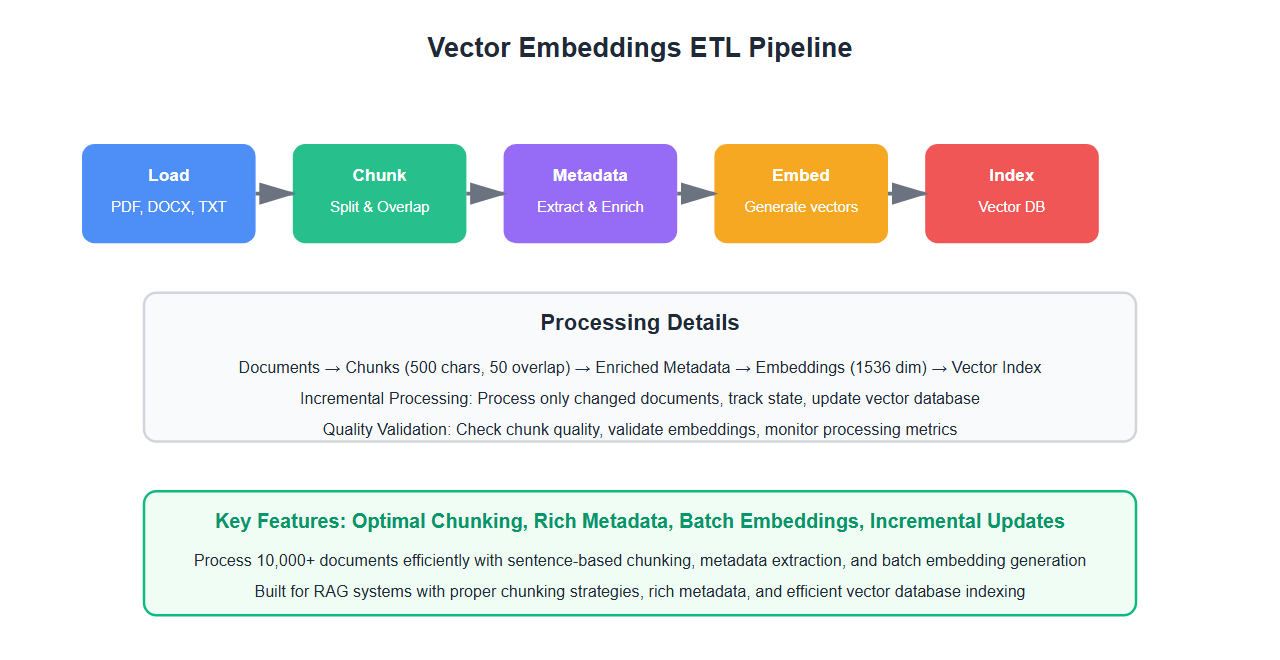
RAG systems require specialized data preparation:
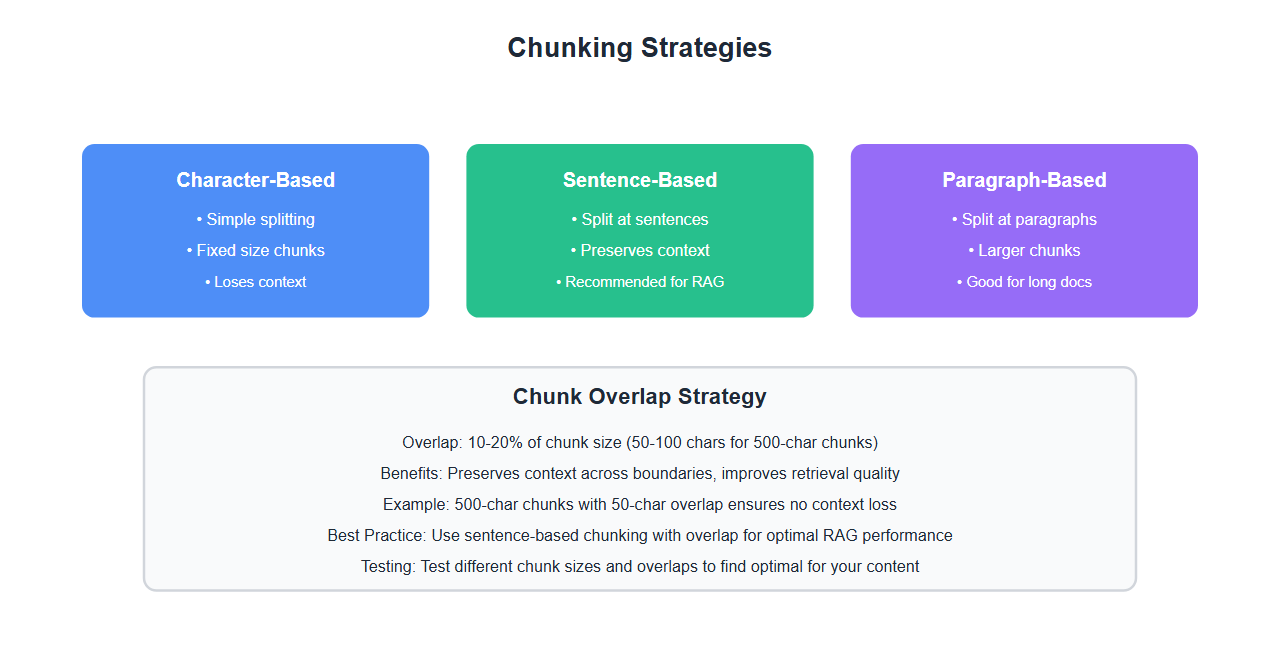
- Chunking: Documents must be split into optimal chunks
- Metadata: Rich metadata is essential for retrieval
- Embeddings: Generate embeddings efficiently at scale
- Indexing: Build efficient vector indexes
- Updates: Handle incremental updates gracefully
After building pipelines for multiple RAG systems, I’ve learned that proper ETL is critical for retrieval quality.
Document Processing Pipeline
1. Document Loading
Load documents from various sources:
from typing import List, Dict, Iterator
from pathlib import Path
import json
import re
from dataclasses import dataclass
import numpy as np

class DocumentLoader:
    def __init__(self):
        self.loaded_documents = []

    def load_pdf(self, file_path: str) -> Dict:
        # Load PDF document
        with open(file_path, 'rb') as f:
            pdf_reader = PyPDF2.PdfReader(f)
            text = ""
            metadata = {
                "source": file_path,
                "type": "pdf",
                "pages": len(pdf_reader.pages)
            }

            for page_num, page in enumerate(pdf_reader.pages):
                text += page.extract_text() + "\n"

            return {
                "text": text,
                "metadata": metadata
            }

    def load_docx(self, file_path: str) -> Dict:
        # Load DOCX document
        doc = docx.Document(file_path)
        text = "\n".join([para.text for para in doc.paragraphs])

        metadata = {
            "source": file_path,
            "type": "docx"
        }

        return {
            "text": text,
            "metadata": metadata
        }

    def load_text(self, file_path: str) -> Dict:
        # Load plain text file
        with open(file_path, 'r', encoding='utf-8') as f:
            text = f.read()

        metadata = {
            "source": file_path,
            "type": "text"
        }

        return {
            "text": text,
            "metadata": metadata
        }

    def load_from_directory(self, directory: str) -> List[Dict]:
        # Load all documents from directory
        documents = []
        path = Path(directory)

        for file_path in path.rglob('*'):
            if file_path.suffix == '.pdf':
                documents.append(self.load_pdf(str(file_path)))
            elif file_path.suffix == '.docx':
                documents.append(self.load_docx(str(file_path)))
            elif file_path.suffix == '.txt':
                documents.append(self.load_text(str(file_path)))

        return documents

# Usage
loader = DocumentLoader()
documents = loader.load_from_directory("documents/")
2. Text Chunking
Split documents into optimal chunks:
from typing import List, Dict
import re
from dataclasses import dataclass

@dataclass
class Chunk:
    text: str
    metadata: Dict
    chunk_id: str
    start_index: int
    end_index: int

class TextChunker:
    def __init__(self, chunk_size: int = 500, chunk_overlap: int = 50):
        self.chunk_size = chunk_size
        self.chunk_overlap = chunk_overlap

    def chunk_by_characters(self, text: str, metadata: Dict) -> List[Chunk]:
        # Simple character-based chunking
        chunks = []
        start = 0
        chunk_id = 0

        while start < len(text):
            end = min(start + self.chunk_size, len(text))
            chunk_text = text[start:end]

            # Try to break at sentence boundary
            if end < len(text):
                # Look for sentence ending
                sentence_end = max(
                    chunk_text.rfind('.'),
                    chunk_text.rfind('!'),
                    chunk_text.rfind('?')
                )
                if sentence_end > self.chunk_size * 0.5:  # If found in second half
                    end = start + sentence_end + 1
                    chunk_text = text[start:end]

            chunk = Chunk(
                text=chunk_text.strip(),
                metadata={**metadata, "chunk_index": chunk_id},
                chunk_id=f"{metadata.get('source', 'doc')}_{chunk_id}",
                start_index=start,
                end_index=end
            )
            chunks.append(chunk)

            # Move start with overlap
            start = end - self.chunk_overlap
            chunk_id += 1

        return chunks

    def chunk_by_sentences(self, text: str, metadata: Dict) -> List[Chunk]:
        # Chunk by sentences
        sentences = re.split(r'[.!?]+\s+', text)
        chunks = []
        current_chunk = []
        current_length = 0
        chunk_id = 0

        for sentence in sentences:
            sentence_length = len(sentence)

            if current_length + sentence_length > self.chunk_size and current_chunk:
                # Create chunk
                chunk_text = ' '.join(current_chunk)
                chunk = Chunk(
                    text=chunk_text,
                    metadata={**metadata, "chunk_index": chunk_id},
                    chunk_id=f"{metadata.get('source', 'doc')}_{chunk_id}",
                    start_index=0,  # Would need to track actual positions
                    end_index=len(chunk_text)
                )
                chunks.append(chunk)

                # Keep overlap
                overlap_sentences = current_chunk[-2:] if len(current_chunk) >= 2 else current_chunk
                current_chunk = overlap_sentences + [sentence]
                current_length = sum(len(s) for s in current_chunk)
                chunk_id += 1
            else:
                current_chunk.append(sentence)
                current_length += sentence_length

        # Add remaining chunk
        if current_chunk:
            chunk_text = ' '.join(current_chunk)
            chunk = Chunk(
                text=chunk_text,
                metadata={**metadata, "chunk_index": chunk_id},
                chunk_id=f"{metadata.get('source', 'doc')}_{chunk_id}",
                start_index=0,
                end_index=len(chunk_text)
            )
            chunks.append(chunk)

        return chunks

    def chunk_by_paragraphs(self, text: str, metadata: Dict) -> List[Chunk]:
        # Chunk by paragraphs
        paragraphs = text.split('\n\n')
        chunks = []
        current_chunk = []
        current_length = 0
        chunk_id = 0

        for para in paragraphs:
            para_length = len(para)

            if current_length + para_length > self.chunk_size and current_chunk:
                chunk_text = '\n\n'.join(current_chunk)
                chunk = Chunk(
                    text=chunk_text,
                    metadata={**metadata, "chunk_index": chunk_id},
                    chunk_id=f"{metadata.get('source', 'doc')}_{chunk_id}",
                    start_index=0,
                    end_index=len(chunk_text)
                )
                chunks.append(chunk)

                current_chunk = [para]
                current_length = para_length
                chunk_id += 1
            else:
                current_chunk.append(para)
                current_length += para_length

        if current_chunk:
            chunk_text = '\n\n'.join(current_chunk)
            chunk = Chunk(
                text=chunk_text,
                metadata={**metadata, "chunk_index": chunk_id},
                chunk_id=f"{metadata.get('source', 'doc')}_{chunk_id}",
                start_index=0,
                end_index=len(chunk_text)
            )
            chunks.append(chunk)

        return chunks

# Usage
chunker = TextChunker(chunk_size=500, chunk_overlap=50)
chunks = chunker.chunk_by_sentences(document["text"], document["metadata"])
3. Metadata Extraction
Extract rich metadata for retrieval:
from typing import Dict, List
import re
from datetime import datetime

class MetadataExtractor:
    def __init__(self):
        self.extracted_metadata = {}

    def extract_entities(self, text: str) -> List[str]:
        # Extract named entities (simplified)
        # In production, use spaCy or similar
        entities = []

        # Extract dates
        date_pattern = r'\d{1,2}/\d{1,2}/\d{4}|\d{4}-\d{2}-\d{2}'
        dates = re.findall(date_pattern, text)
        entities.extend(dates)

        # Extract email addresses
        email_pattern = r'\b[A-Za-z0-9._%+-]+@[A-Za-z0-9.-]+\.[A-Z|a-z]{2,}\b'
        emails = re.findall(email_pattern, text)
        entities.extend(emails)

        return entities

    def extract_keywords(self, text: str, top_n: int = 10) -> List[str]:
        # Extract keywords (simplified TF-IDF)
        words = re.findall(r'\b\w+\b', text.lower())

        # Remove stop words (simplified list)
        stop_words = {'the', 'a', 'an', 'and', 'or', 'but', 'in', 'on', 'at', 'to', 'for', 'of', 'with', 'by'}
        words = [w for w in words if w not in stop_words and len(w) > 3]

        # Count frequencies
        word_freq = {}
        for word in words:
            word_freq[word] = word_freq.get(word, 0) + 1

        # Get top keywords
        sorted_words = sorted(word_freq.items(), key=lambda x: x[1], reverse=True)
        return [word for word, freq in sorted_words[:top_n]]

    def extract_summary(self, text: str, max_sentences: int = 3) -> str:
        # Extract summary (first few sentences)
        sentences = re.split(r'[.!?]+\s+', text)
        summary = '. '.join(sentences[:max_sentences])
        if summary and not summary.endswith('.'):
            summary += '.'
        return summary

    def enrich_metadata(self, chunk: Chunk, document_metadata: Dict) -> Dict:
        # Enrich chunk metadata
        enriched = {
            **chunk.metadata,
            **document_metadata,
            "entities": self.extract_entities(chunk.text),
            "keywords": self.extract_keywords(chunk.text),
            "summary": self.extract_summary(chunk.text),
            "length": len(chunk.text),
            "word_count": len(chunk.text.split())
        }

        return enriched

# Usage
extractor = MetadataExtractor()
enriched_chunks = []
for chunk in chunks:
    enriched_metadata = extractor.enrich_metadata(chunk, document["metadata"])
    enriched_chunks.append(Chunk(
        text=chunk.text,
        metadata=enriched_metadata,
        chunk_id=chunk.chunk_id,
        start_index=chunk.start_index,
        end_index=chunk.end_index
    ))
4. Embedding Generation
Generate embeddings efficiently:
from typing import List, Dict
import numpy as np
from openai import OpenAI

class EmbeddingGenerator:
    def __init__(self, model: str = "text-embedding-3-small", api_key: str = None):
        self.model = model
        self.client = OpenAI(api_key=api_key) if api_key else None
        self.embedding_cache = {}

    def generate_embedding(self, text: str) -> List[float]:
        # Generate embedding for text
        if text in self.embedding_cache:
            return self.embedding_cache[text]

        if self.client:
            response = self.client.embeddings.create(
                model=self.model,
                input=text
            )
            embedding = response.data[0].embedding
        else:
            # Fallback: random embedding for demo
            embedding = np.random.rand(1536).tolist()

        self.embedding_cache[text] = embedding
        return embedding

    def generate_batch(self, texts: List[str], batch_size: int = 100) -> List[List[float]]:
        # Generate embeddings in batches
        embeddings = []

        for i in range(0, len(texts), batch_size):
            batch = texts[i:i + batch_size]
            batch_embeddings = [self.generate_embedding(text) for text in batch]
            embeddings.extend(batch_embeddings)

        return embeddings

    def generate_for_chunks(self, chunks: List[Chunk]) -> List[Dict]:
        # Generate embeddings for all chunks
        texts = [chunk.text for chunk in chunks]
        embeddings = self.generate_batch(texts)

        result = []
        for chunk, embedding in zip(chunks, embeddings):
            result.append({
                "chunk_id": chunk.chunk_id,
                "text": chunk.text,
                "embedding": embedding,
                "metadata": chunk.metadata
            })

        return result

# Usage
embedding_gen = EmbeddingGenerator(model="text-embedding-3-small")
embedded_chunks = embedding_gen.generate_for_chunks(enriched_chunks)
5. Vector Database Loading
Load embeddings into vector database:
from typing import List, Dict
from pinecone import Pinecone, ServerlessSpec

class VectorDatabaseLoader:
    def __init__(self, api_key: str, index_name: str):
        self.pc = Pinecone(api_key=api_key)
        self.index = self.pc.Index(index_name)

    def upsert_chunks(self, embedded_chunks: List[Dict], batch_size: int = 100):
        # Upsert chunks to vector database
        vectors = []

        for chunk in embedded_chunks:
            vector = {
                "id": chunk["chunk_id"],
                "values": chunk["embedding"],
                "metadata": {
                    "text": chunk["text"][:1000],  # Truncate for metadata
                    **chunk["metadata"]
                }
            }
            vectors.append(vector)

            # Batch upsert
            if len(vectors) >= batch_size:
                self.index.upsert(vectors=vectors)
                vectors = []

        # Upsert remaining
        if vectors:
            self.index.upsert(vectors=vectors)

    def update_metadata(self, chunk_id: str, metadata: Dict):
        # Update metadata for existing chunk
        self.index.update(id=chunk_id, set_metadata=metadata)

    def delete_chunks(self, chunk_ids: List[str]):
        # Delete chunks from vector database
        self.index.delete(ids=chunk_ids)

# Usage
loader = VectorDatabaseLoader(api_key="your-api-key", index_name="rag-index")
loader.upsert_chunks(embedded_chunks)
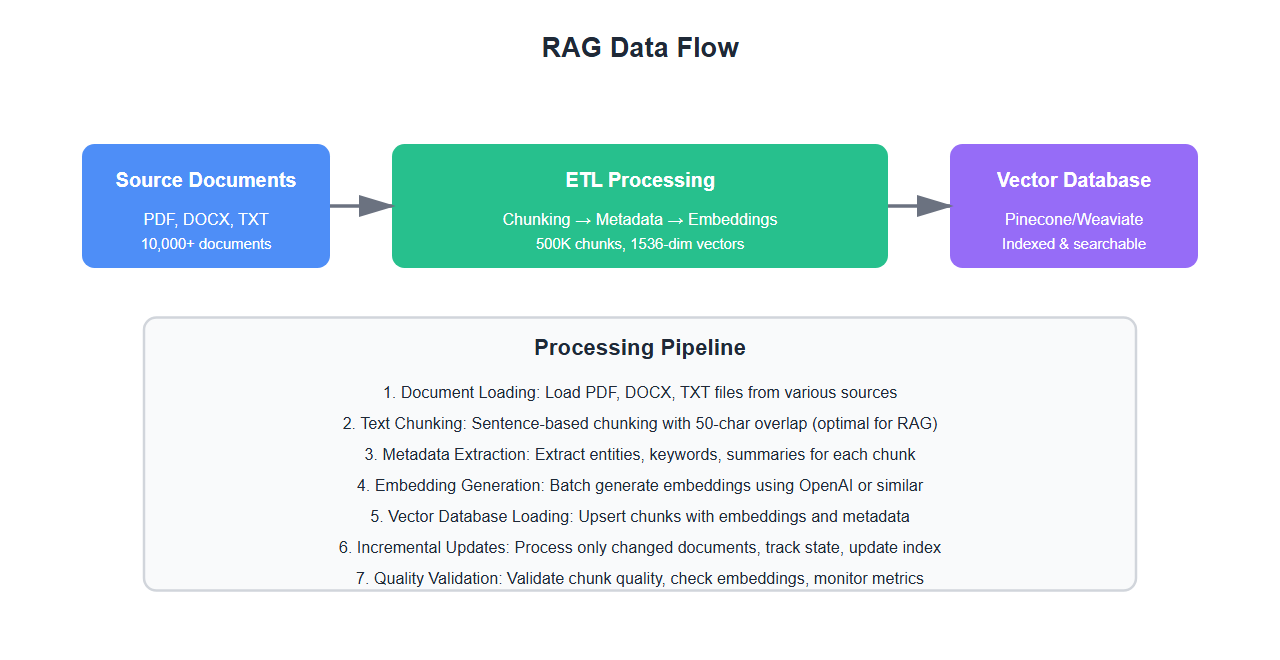
Complete ETL Pipeline
Build a complete pipeline:
from typing import List, Dict
from pathlib import Path

class RAGETLPipeline:
    def __init__(self,
                 chunk_size: int = 500,
                 chunk_overlap: int = 50,
                 embedding_model: str = "text-embedding-3-small",
                 vector_db_api_key: str = None,
                 vector_db_index: str = None):
        self.loader = DocumentLoader()
        self.chunker = TextChunker(chunk_size=chunk_size, chunk_overlap=chunk_overlap)
        self.metadata_extractor = MetadataExtractor()
        self.embedding_gen = EmbeddingGenerator(model=embedding_model)
        self.vector_loader = VectorDatabaseLoader(
            api_key=vector_db_api_key,
            index_name=vector_db_index
        ) if vector_db_api_key else None

    def process_document(self, document_path: str) -> List[Dict]:
        # Process single document
        # Load
        if document_path.endswith('.pdf'):
            doc = self.loader.load_pdf(document_path)
        elif document_path.endswith('.docx'):
            doc = self.loader.load_docx(document_path)
        else:
            doc = self.loader.load_text(document_path)

        # Chunk
        chunks = self.chunker.chunk_by_sentences(doc["text"], doc["metadata"])

        # Enrich metadata
        enriched_chunks = []
        for chunk in chunks:
            enriched_metadata = self.metadata_extractor.enrich_metadata(
                chunk, doc["metadata"]
            )
            enriched_chunks.append(Chunk(
                text=chunk.text,
                metadata=enriched_metadata,
                chunk_id=chunk.chunk_id,
                start_index=chunk.start_index,
                end_index=chunk.end_index
            ))

        # Generate embeddings
        embedded_chunks = self.embedding_gen.generate_for_chunks(enriched_chunks)

        # Load to vector database
        if self.vector_loader:
            self.vector_loader.upsert_chunks(embedded_chunks)

        return embedded_chunks

    def process_directory(self, directory: str) -> List[Dict]:
        # Process all documents in directory
        all_chunks = []
        documents = self.loader.load_from_directory(directory)

        for doc in documents:
            chunks = self.chunker.chunk_by_sentences(doc["text"], doc["metadata"])

            enriched_chunks = []
            for chunk in chunks:
                enriched_metadata = self.metadata_extractor.enrich_metadata(
                    chunk, doc["metadata"]
                )
                enriched_chunks.append(Chunk(
                    text=chunk.text,
                    metadata=enriched_metadata,
                    chunk_id=chunk.chunk_id,
                    start_index=chunk.start_index,
                    end_index=chunk.end_index
                ))

            embedded_chunks = self.embedding_gen.generate_for_chunks(enriched_chunks)
            all_chunks.extend(embedded_chunks)

        # Batch load to vector database
        if self.vector_loader:
            self.vector_loader.upsert_chunks(all_chunks)

        return all_chunks

# Usage
pipeline = RAGETLPipeline(
    chunk_size=500,
    chunk_overlap=50,
    embedding_model="text-embedding-3-small",
    vector_db_api_key="your-api-key",
    vector_db_index="rag-index"
)

# Process single document
chunks = pipeline.process_document("document.pdf")

# Process directory
all_chunks = pipeline.process_directory("documents/")
Incremental Updates
Handle incremental document updates:
import hashlib
from datetime import datetime

class IncrementalRAGPipeline(RAGETLPipeline):
    def __init__(self, state_file: str = "rag_state.json", *args, **kwargs):
        super().__init__(*args, **kwargs)
        self.state_file = state_file
        self.processed_files = self._load_state()

    def _load_state(self) -> Dict:
        # Load processing state
        try:
            with open(self.state_file, 'r') as f:
                return json.load(f)
        except FileNotFoundError:
            return {"processed_files": {}, "last_updated": None}

    def _save_state(self):
        # Save processing state
        state = {
            "processed_files": self.processed_files,
            "last_updated": datetime.now().isoformat()
        }
        with open(self.state_file, 'w') as f:
            json.dump(state, f, indent=2)

    def _file_hash(self, file_path: str) -> str:
        # Calculate file hash
        with open(file_path, 'rb') as f:
            return hashlib.md5(f.read()).hexdigest()

    def process_incremental(self, document_path: str) -> List[Dict]:
        # Process only if file changed
        file_hash = self._file_hash(document_path)
        state = self._load_state()

        if document_path in state.get("processed_files", {}):
            if state["processed_files"][document_path]["hash"] == file_hash:
                # File unchanged, skip
                return []

        # Process document
        chunks = self.process_document(document_path)

        # Update state
        state["processed_files"][document_path] = {
            "hash": file_hash,
            "processed_at": datetime.now().isoformat(),
            "chunks": len(chunks)
        }
        self._save_state()

        return chunks

# Usage
incremental_pipeline = IncrementalRAGPipeline(
    state_file="rag_state.json",
    vector_db_api_key="your-api-key",
    vector_db_index="rag-index"
)

# Only processes changed files
chunks = incremental_pipeline.process_incremental("document.pdf")
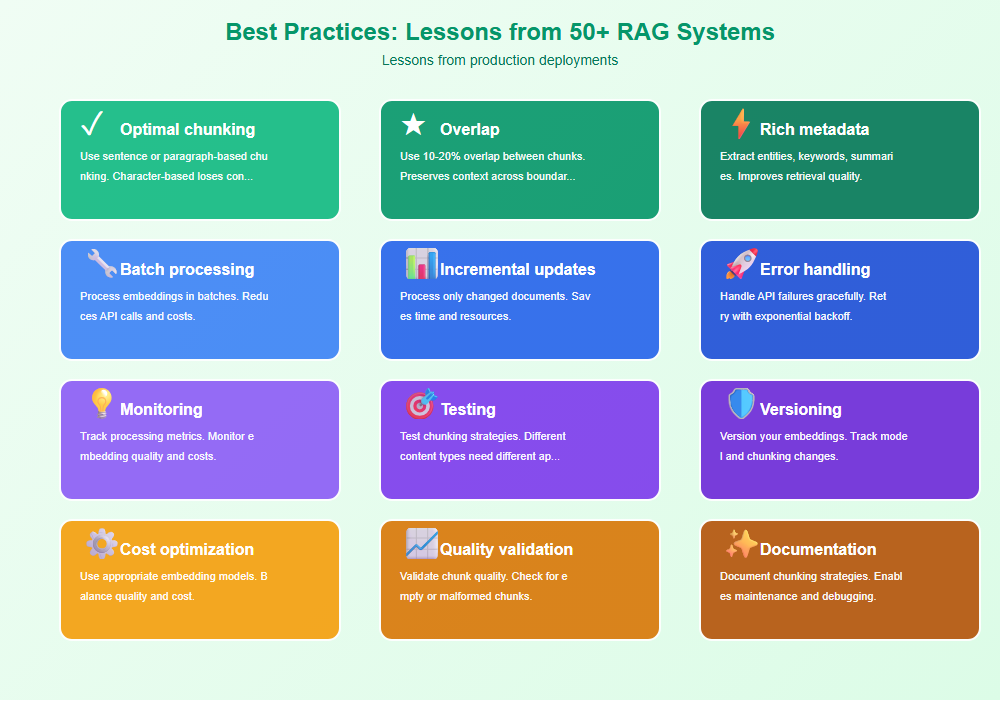
Best Practices: Lessons from 50+ RAG Systems
From building RAG ETL pipelines:
- Optimal chunking: Use sentence or paragraph-based chunking. Character-based loses context.
- Overlap: Use 10-20% overlap between chunks. Preserves context across boundaries.
- Rich metadata: Extract entities, keywords, summaries. Improves retrieval quality.
- Batch processing: Process embeddings in batches. Reduces API calls and costs.
- Incremental updates: Process only changed documents. Saves time and resources.
- Error handling: Handle API failures gracefully. Retry with exponential backoff.
- Monitoring: Track processing metrics. Monitor embedding quality and costs.
- Testing: Test chunking strategies. Different content types need different approaches.
- Versioning: Version your embeddings. Track model and chunking changes.
- Cost optimization: Use appropriate embedding models. Balance quality and cost.
- Quality validation: Validate chunk quality. Check for empty or malformed chunks.
- Documentation: Document chunking strategies. Enables maintenance and debugging.
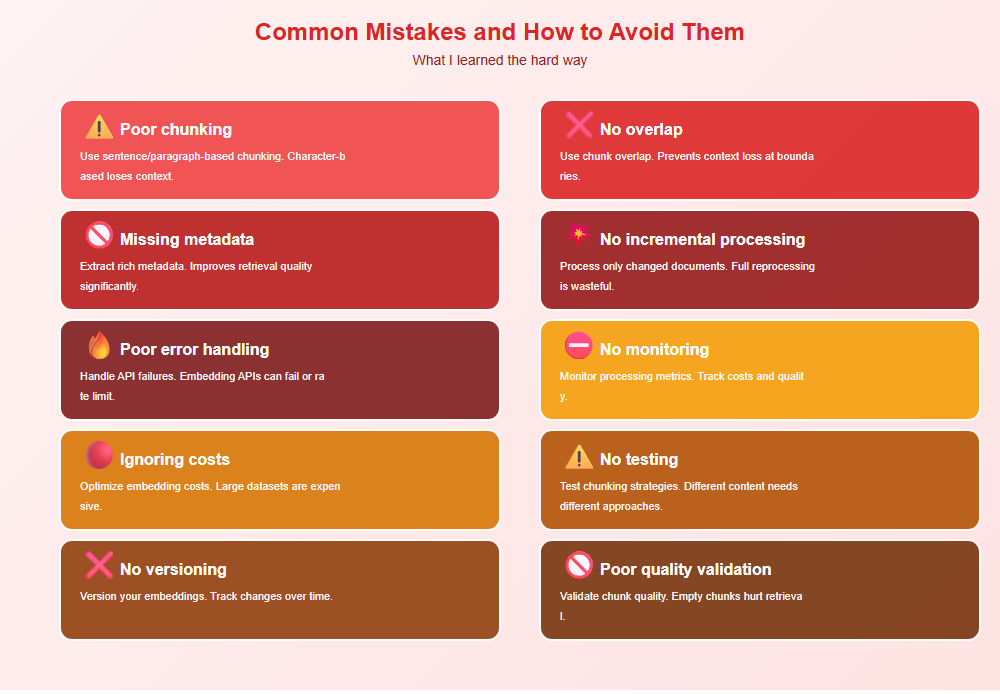
Common Mistakes and How to Avoid Them
What I learned the hard way:
- Poor chunking: Use sentence/paragraph-based chunking. Character-based loses context.
- No overlap: Use chunk overlap. Prevents context loss at boundaries.
- Missing metadata: Extract rich metadata. Improves retrieval quality significantly.
- No incremental processing: Process only changed documents. Full reprocessing is wasteful.
- Poor error handling: Handle API failures. Embedding APIs can fail or rate limit.
- No monitoring: Monitor processing metrics. Track costs and quality.
- Ignoring costs: Optimize embedding costs. Large datasets are expensive.
- No testing: Test chunking strategies. Different content needs different approaches.
- No versioning: Version your embeddings. Track changes over time.
- Poor quality validation: Validate chunk quality. Empty chunks hurt retrieval.
Real-World Example: Building RAG for 10,000 Documents
We built a RAG ETL pipeline for 10,000 documents:
- Chunking: Sentence-based chunking with 50-character overlap
- Metadata: Extracted entities, keywords, and summaries for each chunk
- Embeddings: Generated 500K embeddings using text-embedding-3-small
- Indexing: Loaded into Pinecone with proper metadata
- Incremental: Processed only changed documents daily
Key learnings: Sentence-based chunking with overlap works best, rich metadata significantly improves retrieval, and incremental processing is essential for large datasets.
🎯 Key Takeaway
RAG ETL requires specialized processing. Use optimal chunking strategies with overlap, extract rich metadata, generate embeddings efficiently, and handle incremental updates. With proper ETL, you ensure high-quality vector embeddings that produce better retrieval results.
Bottom Line
RAG ETL requires specialized data preparation. Use optimal chunking strategies with overlap, extract rich metadata, generate embeddings efficiently, and handle incremental updates. With proper ETL, you ensure high-quality vector embeddings that produce better retrieval results. The investment in proper ETL pays off in retrieval quality.
Discover more from C4: Container, Code, Cloud & Context
Subscribe to get the latest posts sent to your email.