For more than a decade, architecting a true active-active multi-region backend on AWS meant accepting a single, non-negotiable reality: you had to model your data in Amazon DynamoDB.
While DynamoDB Global Tables delivered impressive multi-region resilience and single-digit millisecond local write latencies, it forced developers to trade away relational capabilities, complex joins, secondary indexing flexibility, and strict multi-item ACID guarantees. Enterprise teams routinely built elaborate application-layer workarounds to manage eventual consistency, data reconciliation, and conflict resolution.
The general availability of Amazon Aurora DSQL—AWS’s distributed, serverless SQL database with multi-region active-active capabilities—fundamentally shifts this trade-off. For the first time, architects can run standard relational SQL schemas with multi-region write capability and serializable ACID isolation.
However, distributed relational SQL does not abolish the laws of physics. Operating Aurora DSQL in production introduces distinct latency, cost, and concurrency trade-offs that make it a complement to DynamoDB Global Tables, rather than an automatic replacement.
This guide provides a senior practitioner’s decision matrix comparing Aurora DSQL and DynamoDB Global Tables across distributed consensus mechanics, write latency realities, conflict resolution models, and serverless compute scaling.
1. Speed-of-Light Physics: Consensus vs. Asynchronous Replication
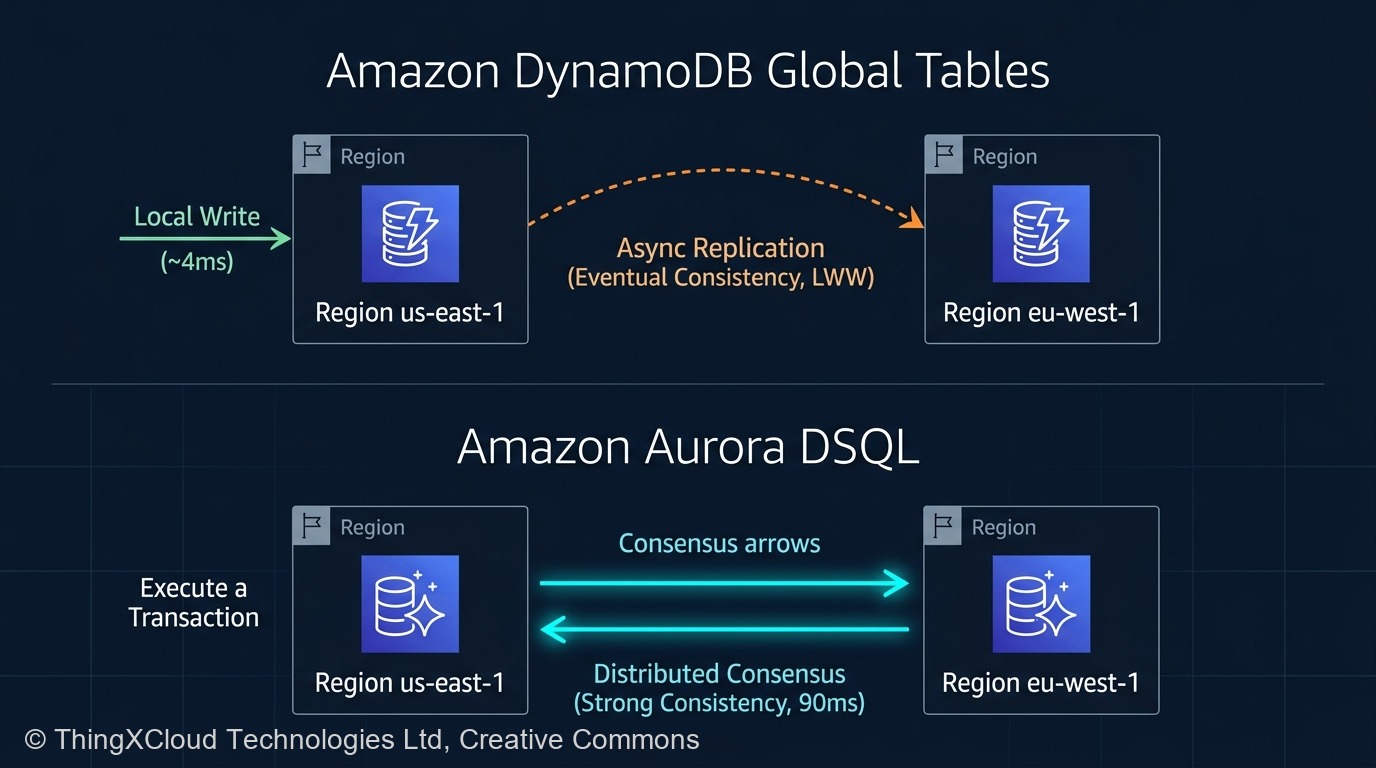
The fundamental difference between Aurora DSQL and DynamoDB Global Tables is where and when the cross-region network hop occurs.
%%{init: {
  'theme': 'base',
  'themeVariables': {
    'actorBkg': '#232F3E',
    'actorBorder': '#FF9900',
    'actorTextColor': '#FFFFFF',
    'actorLineColor': '#FF9900',
    'signalColor': '#0073BB',
    'signalTextColor': '#0F172A',
    'labelBoxBkgColor': '#232F3E',
    'labelBoxBorderColor': '#FF9900',
    'labelTextColor': '#FFFFFF',
    'noteBkgColor': '#232F3E',
    'noteBorderColor': '#FF9900',
    'noteTextColor': '#FFFFFF',
    'activationBkgColor': '#FFF3E0',
    'activationBorderColor': '#FF9900',
    'sequenceNumberColor': '#FFFFFF'
  }
}}%%
sequenceDiagram
    autonumber
    participant AppUS as Client (us-east-1)
    participant DSQL_US as Aurora DSQL (us-east-1)
    participant DSQL_EU as Aurora DSQL (eu-west-1)

    Note over AppUS,DSQL_EU: Aurora DSQL: Synchronous Distributed Consensus
    AppUS->>DSQL_US: INSERT / UPDATE Transaction
    DSQL_US->>DSQL_EU: Consensus Quorum Vote (RTT ~75ms)
    DSQL_EU-->>DSQL_US: Quorum Acknowledged
    DSQL_US-->>AppUS: Transaction Committed (85ms - 120ms)

    Note over AppUS,DSQL_EU: DynamoDB: Local Commit with Async Replication
    participant DDB_US as DynamoDB (us-east-1)
    participant DDB_EU as DynamoDB (eu-west-1)
    AppUS->>DDB_US: PutItem (Local 3-AZ Quorum)
    DDB_US-->>AppUS: Write Confirmed (4ms - 8ms)
    DDB_US-->>DDB_EU: Async Replication Stream (Lag ~800ms)
Aurora DSQL: Synchronous Multi-Region Quorum
Aurora DSQL provides active-active relational ACID transactions across AWS regions. When a client in us-east-1 executes a write against a multi-region DSQL cluster:
1. The transaction coordinator gathers write intents.
2. A distributed consensus protocol (leveraging multi-region quorum slices) requires validation across participating regions before the transaction is allowed to commit.
3. The client does not receive a COMMIT acknowledgment until the quorum confirms the transaction.
Because light traveling through fiber-optic cables takes roughly 5 microseconds per kilometer, the physical round-trip time (RTT) between Northern Virginia (us-east-1) and Ireland (eu-west-1) is bounded by physics to approximately 70–80 milliseconds.
In production, multi-region Aurora DSQL write latency consistently measures between 85ms and 150ms. While reading locally is lightning fast (single-digit milliseconds), writes cannot escape cross-region propagation latency.
DynamoDB Global Tables: Local Commit First, Replicate Second
DynamoDB Global Tables circumvents the speed-of-light penalty by decoupling the client acknowledgment from cross-region replication:
1. A write in us-east-1 reaches the local storage partition nodes.
2. DynamoDB commits the write locally across a 3-Availability Zone Paxos group and immediately returns HTTP 200 to the client in 4ms to 8ms.
3. In the background, DynamoDB Streams asynchronously replicates the change across AWS’s private global backbone to eu-west-1.
The trade-off is eventual consistency: for a window of typically 500ms to 1,500ms, the data in eu-west-1 does not reflect the update performed in us-east-1.
2. Conflict Resolution: Serializable Isolation vs. Last-Write-Wins
How each engine handles concurrent writes to the same record across two different regions defines where each database succeeds or fails.
DynamoDB: The Last-Write-Wins (LWW) Blind Spot
DynamoDB Global Tables resolves concurrent multi-region updates via Last-Write-Wins (LWW) using internal timestamps:
- If a customer updates their shipping address in
us-east-1at10:00:00.100, and a customer service representative simultaneously updates the account notes ineu-west-1at10:00:00.120, the record with the latest timestamp completely overwrites the entire item. - Partial field merging does not occur unless you explicitly design an attribute-level document structure or handle updates via custom streams.
%%{init: {
  'theme': 'base',
  'themeVariables': {
    'primaryColor': '#232F3E',
    'primaryTextColor': '#FFFFFF',
    'primaryBorderColor': '#FF9900',
    'lineColor': '#232F3E',
    'clusterBkg': '#F8FAFC',
    'clusterBorder': '#CBD5E1',
    'edgeLabelBackground': '#FFFFFF',
    'nodeTextColor': '#FFFFFF'
  }
}}%%
flowchart TD
    subgraph ConflictScenario ["Concurrent Writes on Same Key: ORDER-104"]
        ClientUS["Client A in us-east-1
Update Status: PAID"] --> DDB1["DynamoDB us-east-1
TS: 10:00:00.100"]
        ClientEU["Client B in eu-west-1
Update Status: CANCELLED"] --> DDB2["DynamoDB eu-west-1
TS: 10:00:00.140"]
    end

    DDB1 --> Sync["Cross-Region Sync Engine"]
    DDB2 --> Sync

    Sync --> Result["Last-Write-Wins Conflict:
Status becomes CANCELLED
(PAID status silently dropped)"]

    classDef awsNavy fill:#232F3E,stroke:#FF9900,stroke-width:2px,color:#FFFFFF;
    classDef awsBlue fill:#0073BB,stroke:#232F3E,stroke-width:2px,color:#FFFFFF;
    classDef awsRed fill:#8B0000,stroke:#FF4D4D,stroke-width:2px,color:#FFFFFF;
    classDef awsGray fill:#334155,stroke:#94A3B8,stroke-width:1px,color:#FFFFFF;

    class ClientUS,ClientEU awsNavy;
    class DDB1,DDB2 awsBlue;
    class Result awsRed;
    class Sync awsGray;
To prevent silent overwrites in DynamoDB Global Tables, teams must implement Optimistic Concurrency Control (OCC) using conditional expressions:
import boto3
from botocore.exceptions import ClientError

dynamodb = boto3.resource("dynamodb")
table = dynamodb.Table("Orders")

def update_order_status(order_id: str, new_status: str, expected_version: int):
    """
    Safely update order status with optimistic locking across regions.
    """
    try:
        response = table.update_item(
            Key={"OrderID": order_id},
            UpdateExpression="SET #s = :new_status, Version = Version + :inc",
            ConditionExpression="Version = :expected_ver",
            ExpressionAttributeNames={"#s": "Status"},
            ExpressionAttributeValues={
                ":new_status": new_status,
                ":inc": 1,
                ":expected_ver": expected_version
            },
            ReturnValues="UPDATED_NEW"
        )
        return response
    except ClientError as e:
        if e.response["Error"]["Code"] == "ConditionalCheckFailedException":
            # Another region updated this item first
            raise ConcurrentModificationError(f"Conflict on Order {order_id}. Retry required.")
        raise
Aurora DSQL: Distributed OCC and Serializable Aborts
Aurora DSQL enforces strict Serializable ACID isolation across regions:
- If two transactions in different regions attempt to modify the same rows concurrently, DSQL’s distributed concurrency coordinator detects the dependency conflict during the commit phase.
- One transaction commits successfully; the conflicting transaction is rejected with a serialization failure (PostgreSQL error code
40001: serialization_failure). - No data is silently lost or clobbered. However, your application layer must be prepared to catch serialization errors and retry the entire transaction.
import asyncpg
import asyncio
import logging

logger = logging.getLogger(__name__)

async def execute_dsql_transaction_with_retry(pool: asyncpg.Pool, query: str, *args, max_retries: int = 5):
    """
    Executes a transaction against Aurora DSQL, automatically retrying
    on distributed serialization failures (40001).
    """
    for attempt in range(1, max_retries + 1):
        try:
            async with pool.acquire() as conn:
                async with conn.transaction(isolation='serializable'):
                    return await conn.fetch(query, *args)
        except asyncpg.SerializationFailureError:
            if attempt == max_retries:
                logger.error(f"Transaction aborted after {max_retries} attempts due to write contention.")
                raise
            # Exponential backoff with jitter to reduce multi-region collision storms
            delay = (2 ** attempt) * 0.05 + (0.01 * attempt)
            logger.warning(f"Serialization conflict detected (40001). Retrying in {delay:.3f}s...")
            await asyncio.sleep(delay)
3. Serverless Compute Scaling: Connection Pooling vs. HTTP Endpoints
For teams orchestrating thousands of concurrent AWS Lambda executions, connection management often dictates the architectural choice.
| Dimension | DynamoDB Global Tables | Aurora DSQL |
|---|---|---|
| Protocol | Stateless HTTP / HTTPS (SigV4) | PostgreSQL wire protocol over distributed endpoint routers |
| Connection Pooling | Not required. Lambda clients reuse HTTP connections via standard SDK keep-alive. | Native distributed connection routing built into the service; eliminates static RDS Proxy clusters. |
| Concurrency Ceiling | Virtually unlimited partition scaling (tens of thousands of concurrent Lambdas). | Bound by distributed DSQL Processing Unit (DPU) quotas and transaction commit queues. |
| VPC Requirement | Direct access via public endpoint or private VPC Gateway Endpoints (free, zero NAT costs). | Direct access via private Interface VPC Endpoints or secure TLS endpoints. |
DynamoDB remains the gold standard for bursty, high-concurrency serverless architectures because it has zero concept of a database connection slot. 10,000 Lambda microVMs can scale up in 3 seconds to process an SQS backlog without exhausting a database socket pool.
Aurora DSQL modernizes serverless relational access by replacing traditional database connection architectures with a distributed router tier. However, under high write contention across regions, thousands of parallel Lambdas attempting to write to the same relational tables will trigger serialization failure retry loops.
4. Cost Economics: Read/Write Capacity vs. Processing Units
Cost dynamics differ dramatically depending on your write-to-read ratio and query complexity.
DynamoDB Pricing Dynamics
- Replicated Write Capacity Units (rWCU): In a Global Table with two regions, every write incurs 1 WCU in the local region plus 1 rWCU in the remote replica region.
- Storage & Change Streams: You pay for storage in each region plus the internal DynamoDB Streams traffic replicating records between regions.
- Economics: Outstandingly cheap for high-volume key-value lookups and structured point queries. Becomes expensive if you frequently perform massive scans or require secondary index duplications across regions.
Aurora DSQL Pricing Dynamics
- DSQL Processing Units (DPUs): Billed on demand based on CPU and memory consumed during query execution and cross-region consensus coordination.
- Multi-Region Coordination Fee: Transactions touching multi-region tables incur inter-region data transfer and consensus validation charges.
- Economics: Significantly more cost-effective when replacing complex multi-table joins or relational schemas that would require dozens of round-trip DynamoDB queries and custom application-level assembly.
5. The 2026 Decision Matrix
Evaluate your workload against this production comparison:
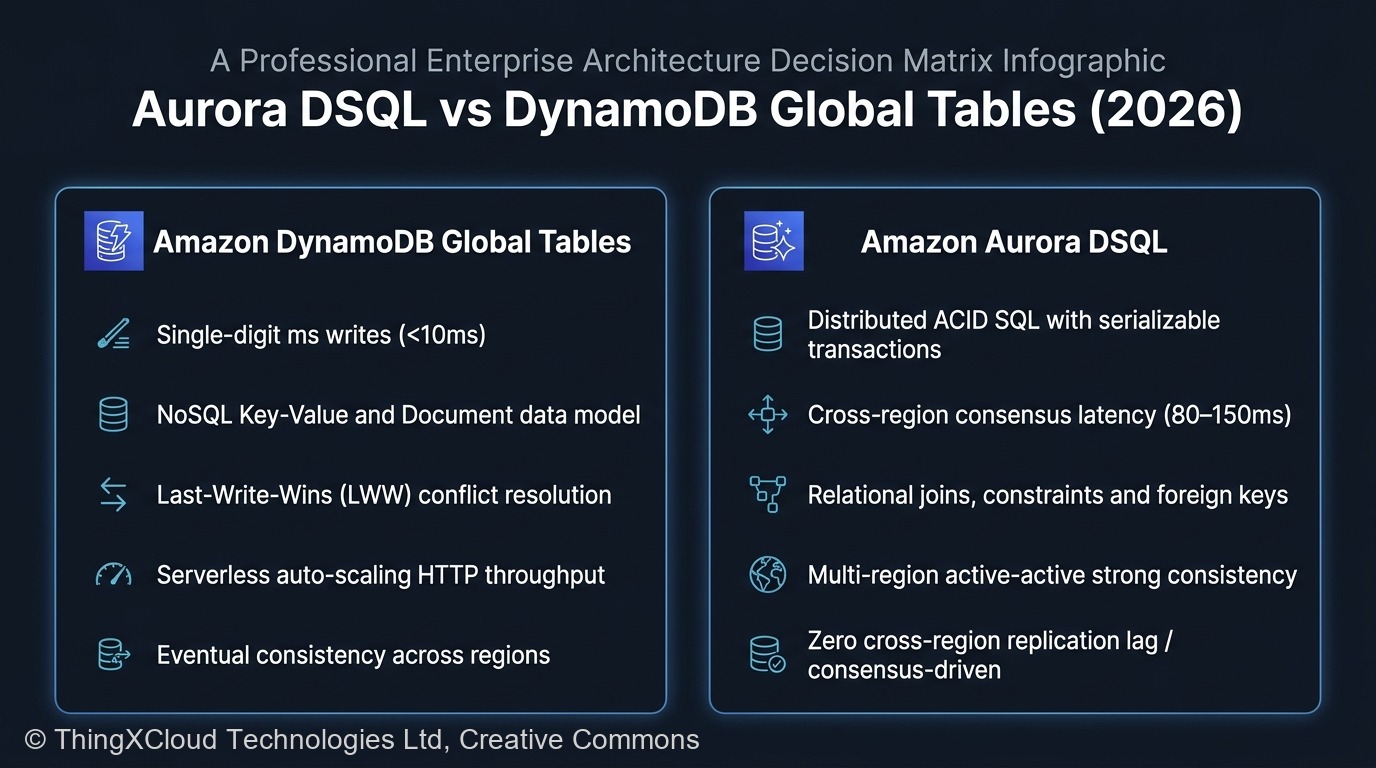
| Evaluation Criteria | Choose DynamoDB Global Tables | Choose Amazon Aurora DSQL |
|---|---|---|
| Write Latency SLA | Must complete in < 10ms globally. | Can tolerate 80ms – 150ms for cross-region consensus. |
| Data Model | Key-value, document, sparse attributes, single-table designs. | Relational entities, normalized schemas, foreign keys, multi-table joins. |
| Isolation Requirement | Eventual consistency acceptable across regions; single-item ACID sufficient. | Strict multi-item, multi-table Serializable ACID transactions required. |
| Write Contention | Low cross-region contention on the same item, or regional data partitioning. | High transactional complexity where stale reads or partial writes cause audit failure. |
| Query Flexibility | Known query access patterns designed upfront via hash and range keys. | Ad-hoc analytics, dynamic filters, SQL GROUP BY, JOIN, and aggregation. |
| Failover Experience | Zero failover time: both regions active, client can redirect immediately. | Zero failover time: both regions active, read and write anywhere. |
Architectural Recommendations
When to Stick with DynamoDB Global Tables
1. Low-Latency User Profiles and Sessions: User session stores, shopping carts, and real-time gaming state where a 120ms write delay degrades the user experience.
2. Region-Affinity Architectures: Workloads where 95% of writes for a specific user occur in their home region (e.g., users in Europe write to eu-west-1), and secondary regions are primarily read replicas or disaster recovery failovers.
3. High-Frequency Ingestion: IoT telemetry, clickstreams, or event logging exceeding 50,000 writes/second.
When to Adopt Amazon Aurora DSQL
1. Core Ledger & Financial Ledgers: Systems where balances, credit allocations, or inventory reservations cannot tolerate Last-Write-Wins overwrites under any circumstance.
2. Migrating Legacy Relational Monoliths: Applications with existing PostgreSQL schemas, complex relational dependencies, or ORMs (Prisma, Entity Framework, Hibernate) that cannot be economically rewritten into DynamoDB single-table designs.
3. Global Multi-Tenant SaaS: Multi-tenant applications where tenants operate globally, requiring relational reporting and strict data consistency without running separate regional database clusters and fragile CDC synchronization pipelines.
References & Further Reading
- → Amazon Aurora DSQL Documentation— Official architectural guide covering distributed SQL processing, active-active multi-region clusters, and PostgreSQL compatibility.
- → Amazon DynamoDB Global Tables Developer Guide— Comprehensive reference on multi-region replication, conflict resolution mechanisms, and version-based optimistic locking.
- → AWS Architecture Blog: Active-Active Multi-Region Architectures— Design patterns for building distributed resilient systems, latency trade-offs, and data partitioning strategies.
- → Jepsen: Distributed Systems Analysis— In-depth analysis of consistency models, network partitions, serializable isolation, and consensus protocols.
Discover more from C4: Container, Code, Cloud & Context
Subscribe to get the latest posts sent to your email.